Disclosure: As an Amazon Associate we earn from qualifying purchases.
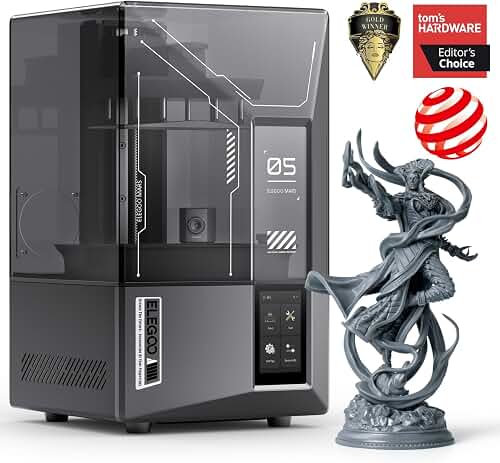
Learning how to print scale car bodies on Elegoo Mars 5 Ultra comes down to four things: choosing a tough or ABS-like resin, slicing the body shell hollow with smart drain holes, building gentle auto-supports on the underside, and curing slowly so panels don't warp. The Mars 5 Ultra's 7.0-inch 9K mono LCD resolves panel lines, badges, and grille meshes down to roughly 18 microns on the X/Y axis, which is exactly what 1/24, 1/18, and 1/10 RC scale car bodies need to look factory-crisp under paint.
This guide walks through the entire workflow — model prep in CHITUBOX, orientation, support strategy, resin pick, exposure tuning, washing, curing, and bodywork — so your first attempt at how to print scale car bodies on Elegoo Mars 5 Ultra comes off the plate ready for primer rather than ready for the bin.
When shopping for how to print scale car bodies on elegoo mars 5 ultra, it pays to compare specs, capacity, and real-world runtime before committing.
Why the Mars 5 Ultra is well-suited to scale car bodies
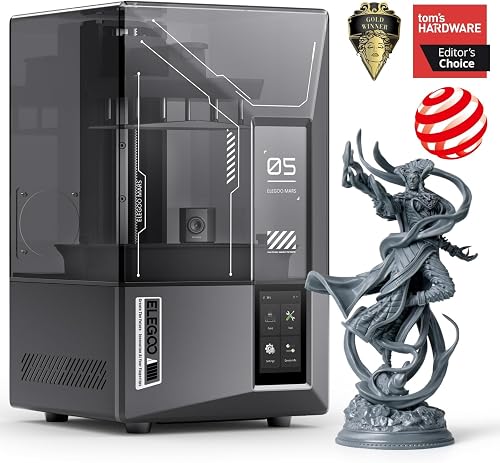
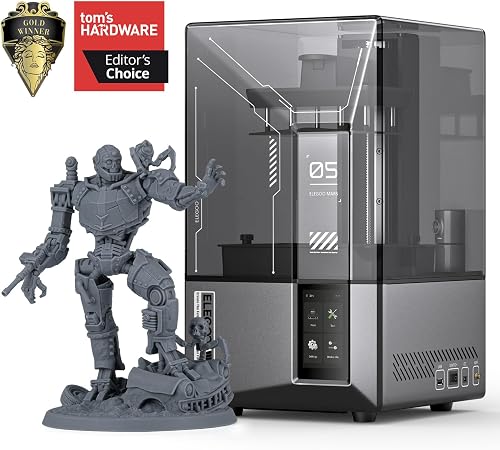
The Mars 5 Ultra pairs an 9K mono LCD with a parallel light source, which means even, sharp pixels across the entire 153 x 77 mm build plate. For a 1/24 Lamborghini Countach body shell or a 1/10 Tamiya-style RC body, that translates to:
- Crisp panel gaps — door, hood, and trunk shutlines stay defined instead of blurring together.
- Readable badges and grille mesh — manufacturer logos and honeycomb intakes resolve without smearing.
- Smooth curved surfaces — long fenders and roofs print without the stepped "voxel rash" you get from older 4K LCDs.
The tilt-release mechanism on the Mars 5 Ultra also reduces peel forces on large flat panels — a hood or roof skin is exactly the kind of geometry that used to tear off supports on older Mars units. If you're new to the platform, our Elegoo Mars 4 Ultra review covers the predecessor and is a useful reference point for what's changed.
Step 1: Prepare the model file
Scale car bodies usually come from one of three sources: paid STL marketplaces (Cults3D, Gambody, MyMiniFactory), free Thingiverse/Printables files, or fan-scanned meshes. Whichever you use, run it through a mesh repair pass first.
- Open the STL in Microsoft 3D Builder or Meshmixer and let it auto-repair non-manifold edges.
- Check that the body is a single watertight shell. If door panels are separate, decide now whether you want them as separate prints (for paint masking) or merged.
- Scale to your target gauge. 1/24 die-cast scale = ~190 mm overall for most sedans, which fits the Mars 5 Ultra plate diagonally. 1/18 will need to be split into front and rear halves.
- If the file is a solid (closed) body, you'll hollow it in the slicer. If it's already hollow, skip ahead to support placement.
Splitting larger scales
For 1/18 or 1/10 RC bodies, use Meshmixer's Plane Cut tool to slice the body just behind the B-pillar. Add a 1 mm peg/socket pair on the cut faces for alignment, then print both halves and bond with thin CA glue. The seam disappears under primer if you sand with 400-grit before painting.
Step 2: Orient the body in CHITUBOX or Voxeldance Tango
Orientation is the single biggest variable in resin print quality. For a car body, the goal is to keep the visible exterior surfaces (hood, roof, fenders, doors) away from supports so they end up perfectly smooth.
The orientation that works best on the Mars 5 Ultra:
- Roof down, nose tilted up roughly 30-40 degrees. This puts all supports inside the wheel arches, under the rocker panels, and on the underbody — places nobody will see.
- Roll the body 5-10 degrees off-axis. This breaks up long parallel cross-sections so peel forces are spread across the print rather than hitting one big slab at once.
- Lift 5 mm off the plate. Never print a car body directly on the build plate — you lose detail and risk warping during release from the FEP.
Step 3: Hollow the body and add drain holes
A solid 1/24 body burns through 80-100 mL of resin and will warp from internal stress. Hollow it to a 1.8-2.2 mm wall thickness. The Mars 5 Ultra handles thinner walls than older units, but 2 mm is the sweet spot for rigidity during sanding and primer work.
Place two drain holes minimum: one inside each rear wheel well, ideally 3 mm in diameter. These let trapped uncured resin escape during the wash step and prevent the dreaded "resin balloon" — a thin-walled body that bulges weeks later because liquid resin slowly cured inside.
Add a third hole inside the trunk floor or under the rear bumper if the body has a long sealed tail section. You can fill these later with a dab of UV resin and a flash from a cure light.
Step 4: Support strategy
For car bodies, manual touch-up of auto-generated supports is non-negotiable. Use CHITUBOX's Auto Support on the Light preset, then:
- Delete every support that lands on the visible upper body — roof, hood, trunk lid, doors above the rocker.
- Add medium supports along the rocker panel underside and door sills.
- Add heavy supports on the underbody floor pan, every 8-10 mm.
- Add a single light support inside each wheel arch on the upper inner fender lip.
- Confirm no support touches headlight lenses, badge recesses, or grille mesh.
Tip contact diameter should sit around 0.35 mm for medium supports and 0.45 mm for heavy. Bigger contact points are easier to clip but leave nubs that need sanding.
Step 5: Pick the right resin
Scale car bodies see three stresses: sanding, drilling for window/light mounts, and (for RC scale) impact during crashes. Standard rigid resin is too brittle for any of these. You want either an ABS-like resin for static display models or a tough/PETG-like resin for RC scale bodies that will get knocked around.
Good options that pair well with the Mars 5 Ultra's exposure profile:
- Elegoo ABS-Like Resin 3.0 — Elegoo's own resin, exposure-tuned for their printers; great surface finish, sands cleanly, holds primer well.
- Siraya Tech Fast ABS-Like — slightly more flexible, harder to crack when you drill mounting holes.
- Phrozen Aqua-Gray 8K — sharpest detail of any resin in this class; best if your body has scripted badges or fine mesh grilles.
- Sunlu Tough Resin — budget-friendly tough option for RC scale where impact matters more than micro-detail.
Mixing 10-15% flexible resin into ABS-like also works — it sands like ABS but tolerates one or two drops without shattering. For more background on resin chemistry and what to expect from each type, see our best resin 3D printers guide.
Step 6: Slicer settings for the Mars 5 Ultra
Start from Elegoo's official profile for whichever resin you choose, then adjust:
- Layer height: 0.05 mm (50 microns). Yes, you can drop to 0.03 mm for show-quality finish, but the time gain rarely shows once paint is on.
- Normal exposure: 2.4-2.8 seconds for most ABS-like resins on the Mars 5 Ultra. Run a validation matrix (Cones of Calibration) any time you change resin bottles.
- Bottom exposure: 25 seconds across 4-6 layers.
- Lift distance: 4 mm at 60 mm/min, then 5 mm at 180 mm/min.
- Anti-aliasing: 4 or 8 — pick the highest your slicer offers. This smooths the stair-stepping on curved fenders dramatically.
- Light PWM: Leave at the Elegoo default unless your resin manufacturer specifies otherwise.
Step 7: Wash, cure, and finish
Pull the body off the plate carefully — a thin plastic scraper works better than a metal one because it doesn't gouge the underbody. Then:
- First wash in dirty IPA or a Mercury wash station for 90 seconds.
- Second wash in clean IPA for 60 seconds.
- Air dry for 15-20 minutes — uncured resin trapped inside will weep out through the drain holes during this time. Wipe it.
- Cure in a UV station for 4-6 minutes per side. Do not over-cure; ABS-like resins go brittle if blasted with UV for half an hour.
- Clip supports with flush cutters, then sand support nubs with 400-grit, finishing with 600 or 800.
- Prime with Tamiya Fine Surface Primer or Mr. Hobby Mr. Surfacer 1500 in light coats.
- Wet sand the primer with 1000-grit, then paint as you would any plastic model body.
Step 8: Mounting hardware (for RC scale)
If you're printing a 1/10 RC body, drill body-post mounting holes after printing using a pin vise. Resin loves to crack around drilled holes if you go too aggressive — start with a 2 mm bit and work up to your final size. Glue a 1 mm thick PETG or polycarbonate reinforcement disk over each hole on the inside of the body before drilling to prevent crack propagation when the body flexes.
Common failure modes and fixes
- Hood or roof has a faint wave pattern: Lift speed too high. Drop to 60 mm/min for the first 4 mm.
- Front bumper is fuzzy or missing detail: Increase exposure by 0.2 sec increments. Resin temperature should be 22-28°C; cold resin under-exposes.
- Body warps after curing: Cured too fast or too hot. Cure in shorter cycles, flipping every 90 seconds.
- Supports tearing the surface: Tip diameter too large or contact depth too deep. Reduce both by 25%.
- Trapped resin pockets visible under paint: Drain holes too small or too few. Add a third hole next time.
How long does it take?
A 1/24 sedan body at 50-micron layers and the orientation above will print in roughly 6-8 hours on the Mars 5 Ultra. A 1/18 body split into halves will be two prints of 8-10 hours each. RC scale 1/10 bodies generally need to be sectioned into 3-4 pieces and run as separate prints, then bonded.
If you're comparing print platforms before committing, our FDM vs resin 3D printer guide covers why resin is the right call for scale car bodywork over filament-based machines — surface finish on FDM prints can't match what the Mars 5 Ultra produces without weeks of bodywork.
Frequently Asked Questions
What is the largest scale car body the Elegoo Mars 5 Ultra can print in one piece?
The Mars 5 Ultra's 153 x 77 x 165 mm build volume comfortably fits a 1/24 scale sedan or coupe (~190 mm long) when oriented diagonally and tilted nose-up. 1/18 bodies (~270 mm) must be split into two pieces. 1/10 RC bodies require sectioning into 3-4 panels.
Can I print clear window glass for my scale car body on the Mars 5 Ultra?
Yes, using a dedicated clear resin like Siraya Tech Simo Clear or Anycubic Clear Resin. Print windows separately as flat thin panels (1.2-1.5 mm thick), polish with progressive grits from 1000 to 4000, and finish with a UV-resistant clear coat. Don't try to print windows as part of the main body shell — exposure for the body is wrong for clear panels.
What resin is best for RC scale car bodies that need to survive crashes?
Tough or PETG-like resins outperform ABS-like for impact resistance. Siraya Tech Tenacious mixed 30/70 with ABS-like resin is a popular RC combo — it sands and paints like ABS but flexes instead of shattering when hit. Pure flexible resin alone is too soft to hold paint cleanly.
How do I get a glass-smooth paint finish on a 3D printed car body?
The sequence is: support nub removal with 400-grit, full body wet sand with 600-grit, prime with high-build automotive primer, wet sand primer with 1000-grit, reprime, wet sand with 1500-grit, then base coat. Skipping the second primer pass leaves voxel lines visible under metallic paints.
Do I need to wash my printed car body with anything other than IPA?
For most ABS-like resins, two IPA baths are enough. Water-washable resins use water but tend to be more brittle and aren't recommended for scale bodies. Some users finish with a quick rinse in Mean Green or Yellow Magic to lift the last surface oils before priming, which improves paint adhesion.
Can the Mars 5 Ultra print body trim, badges, and emblems as separate parts?
Absolutely — that's actually the recommended workflow for show-quality builds. Print badges and trim pieces at 25-micron layers on a separate run, paint them off the body, and attach with Microscale Micro Kristal Klear or thin CA after the main body paint cures. This avoids masking nightmares.
How do I prevent my printed car body from yellowing over time?
Post-cure fully (but don't over-cure), then apply a clear coat with UV inhibitors as your final paint step — Tamiya TS-13 or Mr. Hobby Premium Top Coat both contain UV blockers. Store finished models out of direct sunlight. Generic clear resins yellow within months in a sunny display case; UV-stabilized clear coats slow this dramatically.
Key Takeaways
- Choosing the right how to print scale car bodies on elegoo mars 5 ultra means matching the key features to your specific needs and budget
- Read real customer reviews and check the return policy before you commit
- Also covers: mars 5 ultra 1/24 car body settings
- Also covers: tamiya replacement body resin print
- Also covers: mars 5 ultra exposure for car shells
- Compare value across models — the priciest option is not always the best fit