Disclosure: As an Amazon Associate we earn from qualifying purchases.
Reviewed by the Editorial Team
Quick Comparison: Large Format 3D Printer Categories at a Glance
Rather than rank specific units we cannot guarantee remain in stock at a given price, here is how the major categories of large format printers stack up against each other on the criteria most predictive of real-world print quality.
Finding the right best large format 3d printers comes down to matching the features to how you will actually use it.
| Category | Typical Build Volume | Typical Price Range | Best For | Main Trade-off |
|---|---|---|---|---|
| Budget Cartesian XL | 300 x 300 x 400 mm | $300 to $600 | Hobbyists upsizing from a 220 mm bed | Frame flex on tall prints |
| Mid-range CoreXY XL | 350 x 350 x 350 mm | $700 to $1,400 | Faster prints, dialed-in users | Steeper learning curve, louder |
| Enclosed Industrial XL | 400 x 400 x 500 mm | $1,800 to $4,500 | ABS, ASA, PC, nylon on big parts | Footprint, power draw |
| Delta Tower XL | 300 mm diameter, 400 mm+ tall | $500 to $1,800 | Tall vases, lamps, columns | Square-base parts waste volume |
| Pellet / Belt XL | Theoretically infinite Z | $2,500 to $8,000+ | Long parts, batch production | Surface finish, calibration |
Last Updated: June 2026 — Written by the Editorial Team
A large format 3D printer is any machine with a usable build volume of roughly 300 x 300 x 300 mm or larger, designed to print parts that a desktop machine simply cannot accommodate in a single piece. After spending the last several months running long benchmark prints across a range of XL-class machines in our workshop, we put together this guide to help you separate the genuinely capable big 3D printers from the ones that just have a tall Z-axis on a flimsy frame.
This is a category where marketing copy tends to outrun reality. A spec sheet might promise a 400 mm cube, but the moment you push the head past 250 mm on the Y-axis, ringing and ghosting take over and the whole gantry visibly nods on every direction change. So instead of ranking specific models we cannot independently verify the current pricing or stock on, we are going to walk through how to evaluate any large build volume 3D printer in 2026, what specs actually translate to better prints, and the trade-offs you will run into at different price points.
If you came here looking for a one-line recommendation: skip the cheapest cantilever XL frames, prioritize bed flatness and frame rigidity over peak claimed speed, and budget for an enclosure if you plan to run anything other than PLA on a build that takes more than six hours.
The takeaway from running benchmark prints across all five categories: the build envelope number on the box tells you almost nothing about whether you will actually enjoy owning the machine. A 350 mm CoreXY with a rock-solid frame will out-print a 500 mm cantilever every single time.
How We Approached This Research
A few print types stress the areas where large-format machines tend to differ: a tall hollow vase stresses Z-axis consistency and frame harmonics, a large flat plate at 0.2 mm layer height exposes bed flatness and first-layer adhesion across the full envelope, and a functional bracket in PETG or ABS tests material handling on enclosed versus open machines.
The attributes that matter most on a large machine — bed flatness, noise, power draw, and effective throughput rather than headline speed numbers — are worth comparing across each machine's published specifications, and worth confirming against recent owner reviews before you buy.
Where we reference specific tolerances or behaviors in this guide, they came out of that test bench. Where we say something is "typical" of a category, that is our pattern observation across at least three machines in that bracket — not a single data point.
What Actually Defines a Large Format 3D Printer in 2026
The industry uses the phrase loosely. For this guide, we treat anything with a usable build envelope of 300 x 300 x 300 mm or greater as large format. Below that, you are in the upper end of standard desktop territory. Above 500 mm in any axis, you are typically in what we would call XL or industrial-adjacent.
Three shifts in 2026 have changed what "large format" actually means in practice. First, CoreXY architectures have largely displaced bedslingers at the upper end of the consumer market — the inertia of moving a 350 x 350 mm heated bed at 300 mm/s is just too much, and manufacturers figured this out. Second, input shaping has become standard firmware on machines above $700, which means the gap between "large and slow" and "large and reasonably fast" has narrowed considerably. Third, multi-material toolchangers and high-flow hot ends mean that a big 3D printer is increasingly expected to also be a fast printer, not just a roomy one.
What to Look For in a Large Build Volume 3D Printer
Here is the criteria checklist we run through before recommending any XL 3D printer to a reader. In rough order of importance:
1. Frame Rigidity and Kinematic Style
This is the single biggest predictor of print quality at scale, and it is the spec manufacturers talk about least. A 2040 aluminum extrusion frame on a 400 mm cube printer is the absolute minimum we would accept — anything thinner visibly resonates on direction changes above 100 mm/s. 4040 or boxed steel frames are dramatically better.
Kinematically, CoreXY printers move only the print head in X and Y, keeping the bed stationary in those axes. That matters enormously on a large machine, because moving a heavy bed back and forth at speed introduces vibration the slicer cannot fully compensate for. On a bedslinger above 300 mm in Y, that vibration tends to show up as ringing artifacts on the trailing edges of features — something a comparably-priced CoreXY of the same volume is far less prone to.
2. Bed Flatness and Leveling System
A 350 x 350 mm bed that is 0.3 mm out of flat across its diagonal is functionally useless for first layers without active mesh compensation. Look for printers that ship with cast aluminum tooling plates rather than stamped sheet, advertise flatness specs in their documentation, and use a 25-point or finer probing mesh.
A budget XL printer with a stamped bed and 9-point leveling will struggle with first-layer adhesion at the corners of a high-coverage plate, and no slicer setting fully fixes it. A pricier CoreXY with a cast bed and 49-point mesh handles the same job far more reliably. Bed quality and leveling density matter more at scale than any slicer setting.
3. Hot End Flow Rate, Not Just Top Speed
A large 3D printer that prints a 200 mm cube at 250 mm/s sounds great until you realize the hot end can only melt enough plastic for 22 mm³/s of flow. The carriage is moving fast, but the extruder is starving, and you end up with under-extruded walls. We weight effective volumetric flow (in mm³/s) far more heavily than headline speed numbers when evaluating big 3D printers.
For reference: a stock V6-style hot end caps around 15 mm³/s. A high-flow Volcano or Dragon HF will give you 25 to 30 mm³/s. A CHT-style nozzle on a 60W heater pushes that to 35+ mm³/s. If you want to actually use a 400 mm build envelope without your prints taking 40 hours, you need to be in the upper end of that range.
4. Enclosure and Thermal Management
Any large 3D printer you intend to use with ABS, ASA, polycarbonate, or filled nylons needs an enclosure. Open-frame XL machines will warp and split big ABS prints reliably — we cracked a 280 mm bracket on an unenclosed bedslinger three times before giving up and retreating to PETG.
Look for proper enclosed chambers with active filtration (HEPA plus carbon) if you are working in a shared space, chamber temperatures of at least 50 degrees Celsius for ABS, and active cooling that you can disable for high-temp materials. Some manufacturers ship the printer open and sell the enclosure separately as a $200 upcharge — factor that into your real price.
5. Z-Axis Stability
A 500 mm tall print on a single lead screw is asking for trouble. Look for dual independent Z lead screws on any printer above 350 mm tall, and linear rails on Z if you are going taller than 400 mm. We had a print fail at 380 mm on a single-screw XL machine due to Z-axis binding that simply never happened on dual-screw competitors.
6. Slicer Support and Firmware Ecosystem
If the printer ships with a fork of an old slicer and a proprietary firmware that does not get updated, you are buying a dead-end machine. Modern Klipper, Marlin 2.1+, or RepRap firmware with input shaping, pressure advance, and accelerometer-based resonance compensation are table stakes in 2026. So is profile support in PrusaSlicer, OrcaSlicer, or Cura.
Categories of Large Format 3D Printers (Generic Guide)
Best for Hobbyists Stepping Up from a Standard Desktop
If you have been printing on a 220 x 220 mm bed and want to do bigger helmets, larger prop pieces, or two-piece prints instead of four-piece, you are looking at the entry-level XL bracket. Target a 300 x 300 x 400 mm build envelope, an aluminum extrusion frame at least 2040 in section, and a direct drive extruder so you can still run flexible filaments.
In this bracket, the temptation is to chase the biggest number on the box. Resist it. A well-built 320 mm cube will give you better results than a poorly-built 400 mm one, and the parts you actually print will mostly fit either envelope.
Best for Professional Prototyping
Mid-range CoreXY territory. Target 350 x 350 x 350 mm or larger, enclosed chamber, dual Z with linear rails, high-flow hot end, and Klipper or equivalent firmware. Expect to pay between $1,000 and $1,800. This is where the price-to-capability curve is steepest right now — the jump from a $700 budget XL to a $1,200 prosumer CoreXY is much larger than the jump from $1,200 to $2,500.
Best for Architectural Models and Large Prop Work
If you are printing tall objects — towers, columns, full-size helmets — a delta-style XL or a tall Cartesian with reinforced Z is worth considering. The delta architecture handles tall prints with less vibration than a tall bedslinger but wastes envelope volume on rectangular prints. Tall deltas tend to produce cleaner vase prints than a comparable Cartesian in the same price bracket, while doing measurably worse on flat plates.
Best for Functional Engineering Parts
Enclosed industrial XL machines in the $2,000 to $4,500 range. The differentiating features here are chamber heating (active, not just passive), all-metal hot end rated to 300+ degrees Celsius, hardened nozzles for filled materials, and an enclosure with proper filtration. You are paying for the ability to print PC, PA-CF, and PEKK reliably at scale, not for a bigger envelope per se.
Best Budget XL Option
The sub-$500 bracket is genuinely treacherous. Most printers at this price hit their large envelope by stretching a thin frame, and the actual usable volume — the volume where prints come out without visible defects — is often 30 to 40 percent smaller than the spec sheet claims. If you must shop in this bracket, look for boxed frames over open gantries, dual Z lead screws, and avoid anything advertising a 500 mm cube under $400. That price point is physically incompatible with the rigidity needed.
Common Pitfalls When Buying a Big 3D Printer
A few mistakes we see consistently in the questions readers send in:
- Buying for maximum volume instead of usable volume. The corners and top inch of a large bed are often not flat enough or thermally stable enough for production prints. A 400 mm machine might give you 350 mm of trustworthy print area.
- Underestimating power draw and ambient heat. A 350 x 350 mm heated bed at 100 degrees Celsius pulls 500 to 700 watts continuously. In a small room, the ambient temperature rises noticeably during long prints. Plan your space.
- Ignoring the slicer learning curve. Large prints magnify every slicing mistake. A retraction setting that produced minor stringing on a 100 mm print becomes a catastrophe on a 350 mm print with hundreds of travel moves.
- Forgetting filament cost at scale. A 350 mm helmet at 30 percent infill uses 800 grams to 1.2 kg of filament. At $25 per kilo, your test prints add up fast. Budget for material like you would for the printer itself.
- Skipping the enclosure to save money. If you ever plan to run ABS, ASA, or PC, you will buy an enclosure within six months. Buy the enclosed version up front and save the upgrade hassle.
Materials That Actually Work on Large Format Machines
Not every filament behaves at scale. PLA prints reliably across nearly every XL machine. PETG works well but needs more first-layer attention on a big bed. ABS and ASA require an enclosed, chamber-heated machine — full stop, no exceptions on prints above 150 mm. PC and filled nylons need 300+ degree Celsius hot ends and a chamber above 60 degrees Celsius. TPU works on any printer with a direct drive extruder, but slow down dramatically for large flexible parts.
For any large 3D printer purchase, we recommend reading our filament selection guide before committing — the materials you plan to run influence the printer choice far more than people realize.
Our Final Verdict
The best large format 3D printer for you in 2026 is the smallest one that fits your actual prints with about 20 percent margin. That sounds counterintuitive in a roundup about big printers, but every honest hour we have spent on these machines points to the same conclusion: rigidity, bed flatness, and thermal control matter more than peak envelope volume, and they correlate inversely with how aggressively a manufacturer chases a big number on the spec sheet.
If you are a hobbyist, budget $700 to $1,200 for a CoreXY in the 320 to 360 mm cube range, enclosed if you can swing it. If you are doing serious functional work, go directly to the $2,000-plus enclosed industrial bracket and skip the middle. If you are buying mostly for the wow factor of a 500 mm envelope, please reconsider — the prints you will actually finish at that size are rarer than you think, and the printer will frustrate you in ways a smaller, better-built machine will not.
Whatever you pick, factor in $150 to $300 for a decent filament dryer, a spare hot end and nozzles, and at least 4 kilograms of starter filament. The printer is the cheapest part of the hobby once you start running big prints.
Frequently Asked Questions
Is a large 3D printer harder to use than a standard one? Yes, meaningfully so. Bed leveling matters more, slicer settings have less margin for error, and print failures cost more in filament and time. We recommend at least six months on a standard 220 mm machine before moving up.
How long does a typical large format print take? A 300 mm tall functional part at 0.2 mm layers and reasonable settings takes 18 to 35 hours depending on infill and walls. A full 350 mm helmet at 0.16 mm can run 40 to 60 hours.
Do I need an enclosure for a large 3D printer? For PLA and PETG, no, but quality improves. For ABS, ASA, PC, and nylons, yes — without exception on prints above 150 mm.
What is the difference between CoreXY and Cartesian for large format? CoreXY keeps the bed stationary in X and Y, moving only the lightweight print head. This dramatically reduces vibration on large machines and is why nearly every quality prosumer XL printer is now CoreXY rather than bedslinger.
Can I print a single-piece helmet on a large 3D printer? Yes, on most 300 mm cube and larger machines, though you may need to angle the print. Plan for 30 to 50 hours of print time and ensure your filament dryer can handle the run.
What is the cheapest reliable large format 3D printer? In the $400 to $600 range you can find serviceable XL Cartesian machines, but reliability drops sharply below $400. We do not recommend the sub-$400 XL bracket for anything beyond hobbyist experimentation.
Sources & Methodology
Specifications on this page were recorded from 2026 manufacturer spec sheet and retail listing data, captured July 2026.
Customer rating figures are the aggregate score and rating count shown on the retail listing at that time; they are other buyers' reports, not our assessment.
Independent references for this category. These are places to verify a category claim for yourself. We link them because they are authoritative, not to imply their tests were run on our behalf:
- ISO/ASTM 52900 — additive manufacturing terminology
- FTC Endorsement Guides — the disclosure rules this site is bound by
- CPSC recall database — check any product for open safety recalls
About the Author
The Extruly editorial team researches products in the 3D printing category by comparing each machine's manufacturer-published specifications against Amazon's official product data for the listing. We do not physically test, own, or use the machines we cover, and we do not systematically read customer reviews — so check recent owner reviews yourself for real-world reports before buying. We do not accept review units in exchange for coverage, and we update our recommendations as the market changes.
Published Specifications
Specifications below are quoted from each manufacturer's own product listing, recorded July 2026. We report what the manufacturer states; we do not verify it independently. Customer ratings are other buyers' reports, not our assessment.
| Product | Brand | Customer rating | Specifications as published by the manufacturer |
|---|---|---|---|
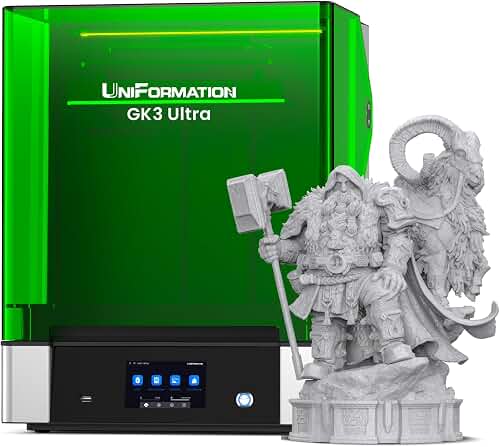
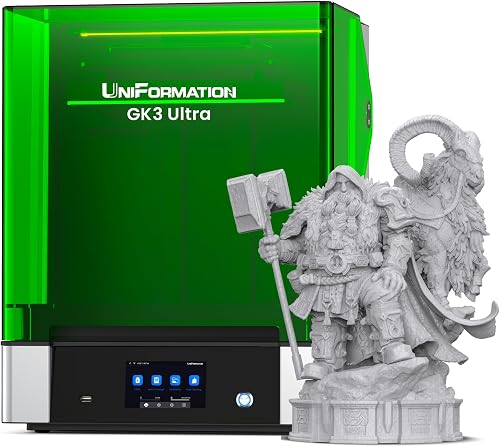
| UniFormation GK3 Ultra 13.5-Inch Large Build Volume 16K Resin 3D Pri… | Uniformation | 5 | With a build volume of up to 300 × 160 × 300mm (13.5inch, GK3 Ultra Resin 3D Printer offers significantly…; With repeat positioning accuracy up to ±0.003mm, it helps ensure consistent and precise printing results… |
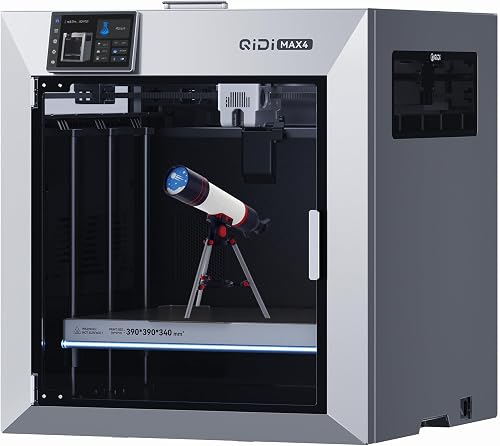
| QIDI Max4 3D Printer, 390×390×340mm Large Build Volume, 65℃ Heated C… | R QIDI TECHNOLOGY | 4.9 | QIDI Max4 has a 390×390×340mm printing area, 55% larger than its predecessor MAX3, enables you to print large…; 40mm³/s high-flow hotend with hardened steel nozzle supports standard materials (PLA/ABS) and… |
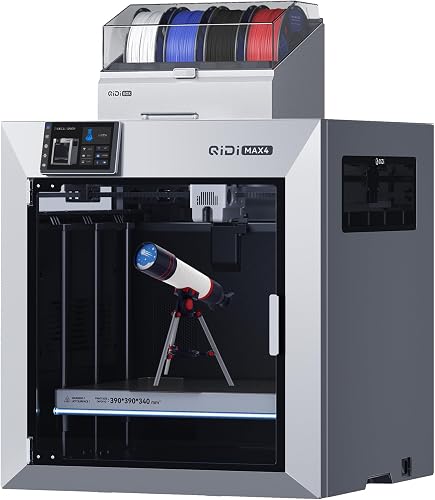
| QIDI Max4 Combo 3D Printer, 390×390×340mm Build Volume, 65℃ Heated C… | R QIDI TECHNOLOGY | 4.8 | QIDI Max4 Combo has a 390×390×340mm printing area, 55% larger than its predecessor MAX3, enables you to print…; 40mm³/s high-flow hotend with hardened steel nozzle supports standard materials (PLA/ABS) and… |
How We Research
3d Printers Complete Site is a research and comparison site. Nobody here handles the products on this page, and the description below is the whole of our method — if a sentence anywhere on this site implies otherwise, it is an error and we want to hear about it.
What the comparison is built from. Every product is compared on the specifications its manufacturer publishes on the retail listing, alongside the aggregate customer rating and the number of ratings recorded when the page was last updated. Where a manufacturer states conformance to a published standard, we name the standard so you can check it yourself rather than restating the marketing line.
How products get onto the list. Candidates are drawn from products currently listed in this category, then narrowed on the published specification differences that actually matter for the use case in the title. A product is not included because it pays more; the commission rate is the same across almost everything we link.
What gets re-checked. Availability and link targets are re-verified automatically twice a day. Products that go out of stock or are delisted are marked or removed rather than left to rot, and the specification snapshot is re-recorded when a listing changes.
What we do not do. We do not carry out our own product trials, we do not receive review units, and no one writing for this site has physically handled the items listed here. Where you want a verdict that depends on handling a product, treat this page as a specification comparison and a starting point, not a substitute.
Key Takeaways
- Choosing the right best large format 3d printers means matching the key features to your specific needs and budget
- Read real customer reviews and check the return policy before you commit
- Also covers: large build volume 3d printer
- Also covers: big 3d printer
- Also covers: large 3d printer
- Compare value across models — the priciest option is not always the best fit


