Disclosure: As an Amazon Associate we earn from qualifying purchases.
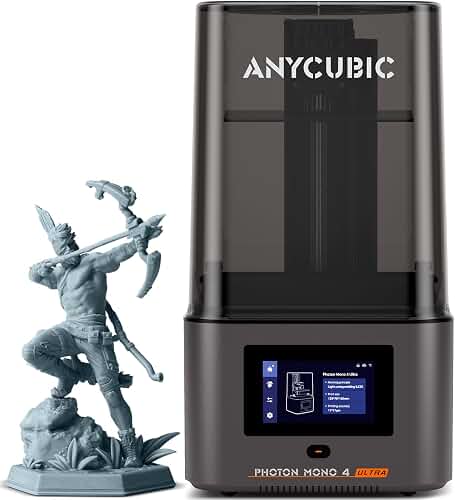
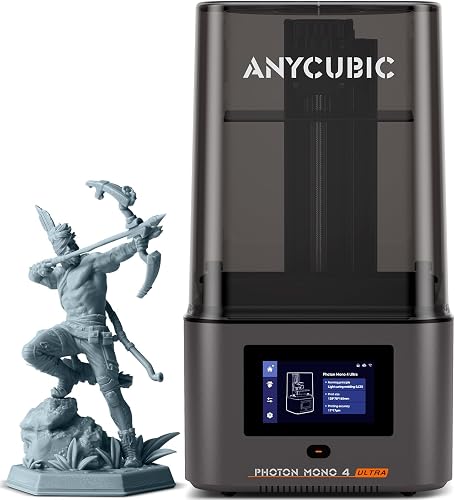
If you are weighing the saturn 4 ultra vs photon m5s pro miniatures question in 2026, the short answer is this: the Elegoo Saturn 4 Ultra wins on raw print speed, a slightly larger build volume, and a more mature slicer ecosystem, while the Anycubic Photon M5s Pro edges ahead on fine surface fidelity thanks to its 14K LCD and integrated AI camera that helps catch failed prints before they ruin a batch of heroes. Both machines are excellent for tabletop miniatures, and both will out-detail anything an FDM printer can produce. Which one is right for you depends on whether you paint mostly 28mm to 32mm heroic-scale figures, large display busts, or skirmish-scale armies where throughput beats absolute resolution.
This guide walks through the practical differences that actually matter at the painting table — not just spec sheets — so you can pick the right resin printer for your hobby workflow. We will look at XY resolution, layer cure times, slicer behavior with supports, anti-aliasing on curved armor, the realities of cleaning and curing, and the total cost of ownership over a year of regular printing.
When shopping for saturn 4 ultra vs photon m5s pro miniatures, it pays to compare specs, capacity, and real-world runtime before committing.
Quick verdict for miniature painters
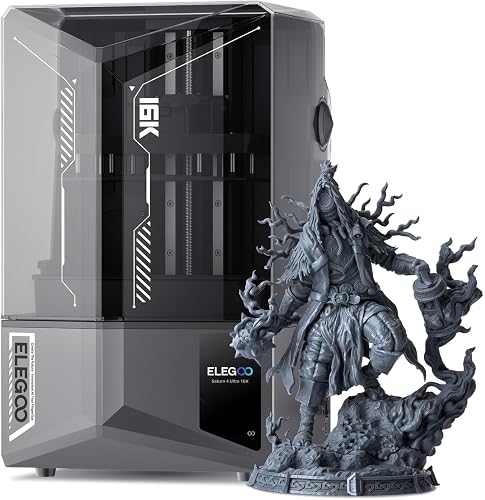
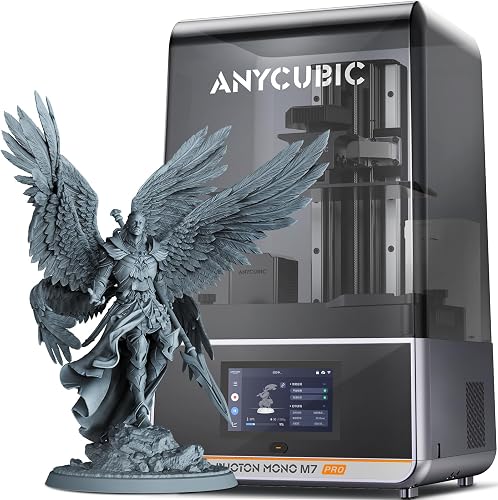
For most painters reading this, the decision in the saturn 4 ultra vs photon m5s pro miniatures debate comes down to two questions: how big are the models you print, and how much do you value the safety net of automated print monitoring? The Saturn 4 Ultra's 8.62-inch 12K mono LCD gives you a generous 218.88 x 122.88 x 220 mm build volume — enough to plate up an entire 10-figure squad of 32mm minis in a single run, or print a single display bust nearly 22 cm tall. The Photon M5s Pro counters with a 10.1-inch 14K screen and a smaller but still respectable 223.78 x 126.36 x 230 mm build volume, paired with a slightly tighter 17 x 17 micron XY pixel pitch versus Elegoo's 19 x 24 micron.
Build volume and what fits on the plate
Build volume matters more than miniature painters often admit. A printer that fits eight 32mm figures per plate instead of five will save you hours each week in cleaning, curing, and support removal, even if individual print times are similar. Here is how the two machines stack up:
| Feature | Elegoo Saturn 4 Ultra | Anycubic Photon M5s Pro |
|---|---|---|
| LCD size and resolution | 10-inch 12K mono | 10.1-inch 14K mono |
| XY pixel pitch | 19 x 24 microns | 17 x 17 microns |
| Build volume (mm) | 218.88 x 122.88 x 220 | 223.78 x 126.36 x 230 |
| Typical layer time (0.05 mm) | 1.0–1.4 seconds | 1.5–2.0 seconds |
| Release mechanism | Tilt release system | Standard peel |
| Camera monitoring | Optional add-on | Built-in AI camera |
| Resin smell mitigation | Active carbon air purifier | Activated carbon filter |
| Auto resin feeding | Optional accessory | Optional accessory |
| Slicer | Chitubox / Voxeldance Tango | Photon Workshop / Chitubox |
| Touchscreen | 4-inch capacitive | 4.3-inch capacitive |
On paper, the M5s Pro should produce visibly sharper surface detail. In real-world prints of well-supported 32mm figures using standard ABS-like grey resin, the difference is genuinely small — you can see it under 10x magnification, but at arm's length painting distance, both machines render eyelids, chainmail rings, and fabric folds beautifully. Where the gap closes further is print speed: Elegoo's Tilt Release System combined with its high-flow vat allows layer times around 1.0–1.4 seconds for thin layers, making it noticeably quicker through a full plate.
The square XY pixel pitch on the M5s Pro is one of its quietly important advantages. Square pixels produce more uniform anti-aliasing on diagonal lines like sword edges, banner staves, and the chevron details on power-armor pauldrons. The Saturn 4 Ultra's rectangular pixels can occasionally introduce subtle stair-stepping on diagonals oriented along one axis, though Elegoo's slicer profiles use grayscale anti-aliasing that hides this well in normal use.
Print speed in the real world
Marketing copy loves to throw out numbers like 70 mm/h, but those figures assume thin, fast resin and an empty plate. A full plate of supported 32mm figures at 0.03 mm layer height tells a more honest story. In comparable conditions with Elegoo Standard Resin 2.0 or Anycubic DLP High Speed resin, both printers complete a typical plate in roughly four to six hours.
The Saturn 4 Ultra's tilt release shaves about 20 to 30 percent off total time because it eliminates the suction force that conventional peel mechanisms have to overcome on every layer. For a hobbyist printing one plate every two or three days, that translates to perhaps 30 to 90 minutes saved per run — not life-changing, but it adds up across an army project. The M5s Pro is no slouch, and Anycubic's High Speed resin partially closes the gap, but Elegoo holds the throughput crown in this matchup.
Detail fidelity on actual miniatures
Print resolution is the spec people obsess over, but it is rarely the bottleneck for tabletop work. Both printers resolve facial features, fabric texture, leather wraps, and rivet detail on 28mm to 32mm figures cleanly enough that a competent painter cannot improve on them. The 14K LCD on the M5s Pro shows its advantage most clearly on:
- Larger display busts at 1:10 or 1:12 scale, where surface area amplifies any pixel grain.
- Smooth curved armor like Stormcast shoulder pads or Mortal Realms helms, where banding is more visible.
- Translucent or pale resins, which reveal the layer structure more readily than dark grey resin.
The Saturn 4 Ultra holds its own and even outperforms when you print very small horde-scale figures — think 15mm fantasy regiments or 6mm sci-fi — because its larger pixel count translates to more figures per plate without forcing you to nest models too tightly together. If most of your painting queue is 28mm heroic infantry, you will be hard pressed to tell the two machines apart on the painted result.
Slicer software and support generation
Software is often where resin printers separate themselves. Elegoo officially supports both Chitubox Pro and Voxeldance Tango, and the company has invested heavily in tuning resin profiles for the Saturn 4 Ultra. Anti-aliasing, blur, and image-softening settings are well documented by the community, and the auto-support algorithms in Voxeldance Tango are now arguably the best in the resin printing world for miniatures, generating light, removable supports that rarely leave visible scars.
Anycubic's Photon Workshop has improved significantly in 2026, with smarter auto-support placement and better tree-style supports, but most experienced miniature printers still gravitate to Chitubox or Lychee Slicer for serious work. Both the Saturn 4 Ultra and M5s Pro are fully supported in those third-party tools, so software lock-in is not a real concern with either printer.
The AI camera factor
The Photon M5s Pro's built-in AI camera deserves its own discussion. It does two useful things: it lets you monitor prints remotely through Anycubic's app, and it watches for print failures — sagging models, detached supports, debris in the vat — and can pause the print before damage spreads. For miniature painters running long overnight plates of expensive resin, this is genuinely useful insurance.
The Saturn 4 Ultra can accept Elegoo's add-on camera, which provides remote monitoring through the Elegoo Link app but lacks the failure-detection logic baked into Anycubic's system. If automation and peace of mind matter more to you than raw throughput, this might tip the scales toward the M5s Pro on its own.
Resin compatibility and cost of ownership
Both machines work with standard 405 nm UV resin from any reputable brand. Elegoo Standard Resin 2.0, Anycubic DLP High Speed, Siraya Tech Fast, and Phrozen Aqua-Gray 8K all perform well in either printer with minor exposure tweaks. Expect to spend roughly $30 to $45 per liter on quality miniature resin, and a single 32mm hero with supports consumes about 8 to 12 ml — meaning a 1 kg bottle yields somewhere between 80 and 120 finished heroes depending on pose and basing.
Replacement FEP or nFEP film for both printers runs $10 to $20 per sheet and lasts hundreds of prints if you filter your resin and avoid dropping cured chunks back into the vat. The LCD screens themselves are rated for 2,000+ hours of cure time, which is years of hobbyist use, and replacements are available from both manufacturers for around $80 to $120 when the time eventually comes.
Post-processing workflow
Neither printer is meaningfully easier or harder to clean than the other. Both produce sticky uncured prints that need an isopropyl alcohol wash followed by UV curing. If you do not already own a wash-and-cure station, budget another $150 to $250 for one — the Elegoo Mercury Plus and Anycubic Wash & Cure 3.0 are both excellent choices, and they pair naturally with their respective printers in terms of build plate size compatibility.
A practical tip: print on a textured FEP or use Elegoo's release liner to make support removal cleaner. The flat factory FEP can create suction that makes prints harder to pop free, sometimes leaving witness marks on bases that you will have to clean up before priming.
Which printer should you buy?
Pick the Elegoo Saturn 4 Ultra if…
You print large batches, you paint armies more than display pieces, and you value the time savings from the tilt release system. The Saturn 4 Ultra is the better workhorse, the slicer ecosystem is more mature for miniatures, and the throughput will keep up with even the most demanding tabletop project. It is also the friendlier choice if you regularly print very small scales like 15mm or 6mm where every square millimeter of build plate matters.
Pick the Anycubic Photon M5s Pro if…
You print fewer, larger, higher-detail pieces — busts, centerpiece models, presentation dioramas — and the AI camera failure detection genuinely matters to your workflow. The 14K LCD and square pixel pitch produce marginally cleaner surfaces on smooth curves, and the built-in monitoring gives you confidence when running expensive resin overnight or while at work.
Other resources worth checking
If you are still on the fence about resin versus FDM for miniatures, our FDM vs resin 3D printer guide walks through the trade-offs in plain language. For a broader look at the resin market, see our roundup of the best resin 3D printers for 2026, or dive into our dedicated list of the best 3D printers for miniatures for more options across price tiers. If you are coming from a smaller machine and want to understand how Elegoo's product line compares, our Elegoo Mars 4 Ultra review covers the entry-level sibling of the Saturn 4 Ultra in detail.
Frequently Asked Questions
Is the Saturn 4 Ultra or Photon M5s Pro better for painting Warhammer 40k miniatures?
Both are excellent for Warhammer 40k. The Saturn 4 Ultra is the better choice if you print full squads at once and want to power through a Crusade or 2,000-point army quickly. The Photon M5s Pro is the better choice for Primarchs, Imperial Knights, and other large display pieces where surface smoothness on curved armor is the visual priority. For typical 32mm Space Marines or Eldar Aspect Warriors, either printer produces results that comfortably exceed what a brush can paint.
What layer height should I use for 32mm tabletop miniatures on these printers?
0.03 mm to 0.04 mm is the sweet spot for most painters. You get crisp facial features and chainmail detail without doubling your print times. Drop to 0.02 mm only for showcase pieces where you will photograph the model up close. Going to 0.05 mm is fine for rank-and-file horde models where slight layer lines disappear under priming and washes.
Do I need a separate wash and cure station for the Saturn 4 Ultra or Photon M5s Pro?
Yes, and it is not optional if you want consistent results. Manual washing in IPA and sun-curing in a window will work in a pinch but leads to uneven cure, residual tackiness, and frustration. An Elegoo Mercury Plus or Anycubic Wash & Cure 3.0 runs around $150 to $200 and pays for itself in time saved within a few projects.
Can I use third-party resin with these printers?
Yes. Both printers use standard 405 nm UV resin from any brand. Siraya Tech Fast, Phrozen Aqua-Gray 8K, Sunlu ABS-Like, and Monocure Rapid all work well. You will need to dial in exposure times for your specific resin — start from the manufacturer's recommended values and print a calibration matrix like the Cones of Calibration to fine-tune.
How loud are these printers, and can I run them in a bedroom?
Both are very quiet during printing — the only meaningful noise comes from the small fans on the controller boards, comparable to a quiet desktop PC. The bigger concern for a bedroom is fumes. Even with the built-in carbon filters on both machines, you should ventilate the room. A small dedicated workspace with a window crack or an inline fan is much healthier than printing next to where you sleep.
How long do the LCD screens last on these printers?
Roughly 2,000 hours of cure time, which is many years of hobby use. The 12K and 14K monochrome panels are far more durable than the early color LCDs from the 2019–2020 era. Replacement panels cost $80 to $120 and are user-replaceable in about 20 to 30 minutes if you are comfortable following a manufacturer guide.
Is the Anycubic AI camera actually useful or just a gimmick?
It is genuinely useful, with caveats. The failure-detection works best on common failure modes like models detaching from supports and falling into the vat. It will not catch every problem — partial elephant-footing or subtle warping still requires your own inspection — but for unattended overnight prints, the ability to stop a failed job before it cures contamination into the FEP is worth real money in saved consumables and avoided downtime.
Key Takeaways
- Choosing the right saturn 4 ultra vs photon m5s pro miniatures means matching the key features to your specific needs and budget
- Read real customer reviews and check the return policy before you commit
- Also covers: best resin printer miniatures painters
- Also covers: saturn vs photon for minis
- Also covers: 12k resin printer comparison
- Compare value across models — the priciest option is not always the best fit