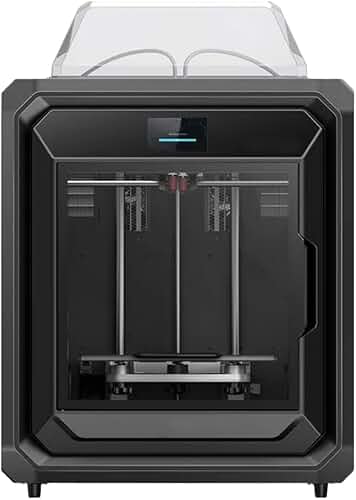
Head-to-head comparison for prop work
| Criterion | Bambu Lab H2D | Prusa MK4S |
|---|---|---|
| Build volume | ~350×320×325 mm (one-piece long guns) | 250×210×220 mm (most pistols, split rifles) |
| Throughput on a 30-unit batch | Excellent (CoreXY + dual nozzle) | Good (single nozzle, slower but reliable) |
| Multi-color (safety bands, two-tone trainers) | Native dual-nozzle, low purge | Requires MMU3 or painting |
| First-layer repeatability across weeks | Very good | Best-in-class (load-cell probe) |
| Engineering materials (PA-CF, PC, ABS) | Enclosed, dual-nozzle handles abrasives well | Open frame; enclosure recommended for ABS/ASA |
| Ecosystem openness / auditability | More closed; cloud-tied features | Fully open; PrusaSlicer + public firmware |
| Long-term parts availability | Unknown (newer platform) | Excellent (10+ year track record) |
| Operator skill needed | Low — appliance-like | Low-medium — more tweakable |
| Capital cost | Higher | Lower |
For prop makers building inert firearms training replicas, the bambu lab h2d vs prusa mk4s for firearms training prop makers decision usually comes down to throughput versus repeatability. The Bambu Lab H2D is a dual-nozzle, large-format CoreXY that crushes batch jobs and multi-material grip stippling, while the Prusa MK4S is a bedslinger built around open hardware, predictable tolerances, and a service ecosystem that survives 24/7 training-academy abuse. If you produce dozens of identical blue-gun trainers per week, the H2D wins on speed and color separation. If you build one-off SIRT-style trainers, custom holster fit models, or safety-orange inert replicas where every print must drop into the same jig, the MK4S is the safer pick.
Below is a practical, production-floor comparison written specifically for shops making non-firing training props, force-on-force markers, dry-fire mockups, and instructor demo aids — not for hobbyists printing display models.
What firearms training prop makers actually need from a 3D printer
Training prop work is unusual. The print is not the product — the repeatable print is. An instructor cadre orders 30 identical inert M4 lowers for a low-light class, and every one needs to accept the same rail, same trigger guard insert, and same weighted barrel slug. That puts four demands on the machine:
- Dimensional repeatability across builds. Trigger guards, mag wells, and rail interfaces fail at ±0.3 mm. You need a printer whose first layer and Z-offset behave the same on Monday morning as they did Friday night.
- Safety-orange or training-blue color fidelity. Most ranges require non-firing trainers to be visually distinct. Multi-material printers let you co-print a contrasting safety band without painting.
- Material breadth. PLA is fine for classroom mockups. Force-on-force and Simunition-adjacent work needs PETG, PA-CF, or PC blends that survive drops, sweat, and 110 °F vehicle interiors.
- Auditability. If a department buys 50 inert pistols from you, they want a slicer profile and a documented process they can re-run in two years. Open ecosystems matter.
The H2D and MK4S answer those four demands very differently.
Bambu Lab H2D: the throughput machine
The H2D is Bambu's dual-nozzle, dual-extruder CoreXY with a 350×320×325 mm build volume (roughly — verify against the current spec sheet at purchase). For prop makers, three features matter:
- Two independent hotends. You can run safety-orange ABS in one nozzle and a structural PA-CF in the other without the purge waste of a single-nozzle AMS swap. A full-size inert AR lower with an integrated orange muzzle cap prints in one job instead of two.
- Build volume that swallows long guns. An MP5-pattern training shell or a full inert rifle handguard fits on the bed in one piece, eliminating the seam that always cracks first when a recruit drops the prop.
- Speed. Real-world throughput on a Bambu CoreXY is 2-3× a bedslinger for the same part quality, which matters when a PD calls Thursday for a Monday class.
The trade-offs are real. Bambu's ecosystem is more closed than Prusa's; firmware and slicer changes ship on Bambu's schedule, not yours. If your shop has been burned by a vendor pushing a breaking update mid-contract, that risk is non-zero. The H2D is also a substantially more expensive capital purchase, and the dual-nozzle system adds maintenance surface area — two hotends means twice the clogs, twice the nozzle wear, twice the calibration.
When the H2D is the right pick
Choose the H2D if you are running a small business that fulfills bulk orders for training academies, police departments, or military units; if your typical SKU is a multi-color inert long gun; and if your operator is comfortable with a more appliance-like, less-tinkerable platform. For more context on the broader Bambu lineup, see our Bambu Lab X1 Carbon review — the H2D inherits much of that machine's motion system and quirks.
Prusa MK4S: the repeatability machine
The MK4S is the 2024-refresh of Prusa's flagship bedslinger: a single-nozzle i3-geometry printer with a 250×210×220 mm build volume, Nextruder hotend, load-cell-based first-layer calibration, and the full open-source Prusa ecosystem (PrusaSlicer, public firmware repos, granular parts availability). For prop makers, its strengths are unglamorous but decisive:
- First-layer consistency. The load-cell probe re-zeros at the start of every print against the actual nozzle tip, not an inductive proxy. Across 50 identical trigger guards, the variance in first-layer thickness is the lowest of any sub-$1500 printer.
- Service longevity. Prusa still sells every replaceable part for the MK3 from 2017. A training-academy customer who buys an MK4S today can expect a documented, supported machine in 2032.
- Open slicer profiles. You can hand a department a PrusaSlicer project file and a roll of Prusament and they can re-run your part themselves. That auditability is a real sales advantage when bidding on government contracts.
- Input shaper + 0.6 mm nozzle. A 0.6 mm nozzle on the MK4S prints a SIRT-sized pistol shell in about 4-5 hours at quality indistinguishable from the 0.4 mm default. For most trainer geometries, that is the right speed/detail balance.
Trade-offs: single nozzle means color separation requires the MMU3 add-on (more failure points) or post-print painting. Build volume cannot accept a one-piece full-length rifle handguard. And while the MK4S is fast, it is not H2D-fast — a bedslinger physically cannot match a well-tuned CoreXY on long Y moves.
When the MK4S is the right pick
Choose the MK4S if your shop produces custom or low-volume trainers, if your customers value documented and reproducible process, if you need confidence that the machine you buy in 2026 will still be supportable in 2032, and if you are comfortable splitting longer parts across multiple prints. Our standalone Prusa MK4S review covers the calibration workflow in more depth.
Material choice for inert training props
The printer decision interacts heavily with material choice. A few guidelines that apply to both machines:
- PLA is acceptable for classroom-only static mockups but will deform in a hot car and snap on a hard drop. Avoid for any force-on-force work. See our PLA filament guide for the temperature and impact limits.
- PETG is the workhorse for trainer shells: tough, paintable, holds tolerance, survives sweat and gun oil. Most of your inventory should be PETG.
- PA-CF (nylon + carbon fiber) is the right answer for high-stress components — rail mounts, weight slugs, anything a recruit will yank on. Both the H2D and MK4S handle it, but the H2D's enclosed chamber gives better layer adhesion on large nylon parts.
- ASA or ABS for outdoor or vehicle-interior storage. The H2D is enclosed out of the box; the MK4S needs an aftermarket enclosure for consistent ABS results.
Whichever printer you pick, color your filament rather than painting. Painted safety bands chip on the first day of a class; co-printed or dyed-in-the-pellet color survives the life of the prop.
Legal and policy considerations
This is not legal advice, but a few practical points every prop maker should internalize:
- Federal law in the U.S. (and most state statutes) treats inert, non-firing training replicas as toys or props rather than firearms, but the rules vary sharply by jurisdiction. Many states and municipalities require a permanent orange muzzle marking on any imitation firearm; co-printing the marking in safety orange (an H2D strength) avoids the legal exposure of a paint band that wears off.
- Never print components that could be assembled into a functioning firearm. That is a different niche, different legal regime, and outside the scope of this guide.
- Keep a paper trail. Departments and academies buying trainers from you will increasingly ask for printer model, material lot, and slicer settings. The MK4S's open ecosystem makes this trivial; the H2D's cloud-tied workflow requires more discipline to export and archive.
Workflow recommendations
Regardless of which machine you pick, three workflow choices separate professional prop makers from hobbyists:
- Build a jig library. Every SKU should have a physical go/no-go gauge. Print it once on a calibrated machine, label it, and check every batch against it. This catches drift before a customer does.
- Track nozzle hours. Abrasive filaments (PA-CF, glow-in-the-dark, anything filled) chew nozzles. A hardened steel nozzle on either printer is good for roughly 500-800 hours of PA-CF before dimensional drift becomes visible. Log it.
- Run a monthly calibration print. Pick one standard part — a XYZ cube plus a thin-wall tolerance ring — and print it on the first of every month from the same filament spool. Archive the measurements. When a customer complaint hits, you can prove whether the machine drifted.
For a broader look at how to think about throughput-vs-quality trade-offs across the current market, our best fast 3D printers roundup covers the CoreXY landscape, and the best enclosed 3D printers guide is the right next read if you expect to run a lot of ABS or ASA.
The verdict for the bambu lab h2d vs prusa mk4s for firearms training prop makers question
If you are picking one printer and your business model is bulk orders of multi-color inert long guns for departments and academies, buy the H2D. The build volume, dual nozzle, and CoreXY speed will pay for the higher capital cost inside the first year.
If you are picking one printer and your business is custom, low-volume, audit-friendly trainers — instructor demo pieces, holster fit models, force-on-force pistol shells, SIRT-style dry-fire trainers — buy the MK4S. The repeatability, open ecosystem, and long service life are worth more than raw throughput.
If you can afford two machines, the right shop layout is an H2D for batch work and an MK4S for prototyping and one-offs. They complement each other rather than overlap.
Frequently Asked Questions
Can I legally 3D print inert firearm training props for sale to police departments?
In most U.S. jurisdictions, yes, provided the props are clearly non-functional, cannot be readily converted to fire a projectile, and comply with state and local imitation-firearm marking laws (typically a permanent orange muzzle band or full safety-orange coloration). Always verify with a firearms attorney in your state before selling, and check any specific contracting requirements from the buying agency. This article is not legal advice.
What filament is best for force-on-force training props that get dropped and thrown?
PETG is the right default — tough, impact-resistant, easy to print, and paintable. For high-stress structural components like rail mounts or weight slugs, step up to PA-CF (carbon-fiber-filled nylon), which both the H2D and MK4S can run with a hardened steel nozzle. Avoid PLA for any prop that will see real handling; it gets brittle and shatters on hard drops.
Do I need a multi-material printer to make two-tone safety-orange training pistols?
Not strictly. A single-nozzle MK4S can print the body and then a separate orange muzzle cap that bonds with solvent or epoxy. But if you are making 20+ units a week, the H2D's dual nozzle eliminates the second print and the bonding step, paying back the price difference quickly. For one-offs, paint or post-bond is fine.
How long does a hardened steel nozzle last when printing carbon-fiber-filled nylon for trainer parts?
Roughly 500-800 print hours before dimensional drift becomes visible on critical features, though this varies with filament brand and print speed. Track nozzle hours per machine and swap proactively — a worn nozzle that fails a tolerance check mid-batch will cost more than a $15 replacement.
Is the Bambu Lab H2D build volume large enough for a one-piece inert AR-15 lower receiver?
Yes. The H2D's ~350 mm long axis comfortably accommodates a full inert AR-15 lower oriented diagonally, and even most pistol-caliber carbine shells fit in one piece. The MK4S cannot — you will split the lower into upper and lower halves and bond them, which is a perfectly acceptable approach but adds a step.
Which printer is better for repeatable trigger-guard tolerances across a 50-unit batch?
The MK4S, narrowly. Its load-cell first-layer probe re-zeros against the actual nozzle tip at the start of every print, producing the tightest first-layer consistency in this price class. The H2D is very good, but if your jig fit tolerance is ±0.15 mm or tighter, the MK4S is the safer bet.
Can I use a Bambu Lab P1S or X1 Carbon instead of the H2D for prop work on a smaller budget?
Yes, with caveats. The P1S and X1 Carbon are excellent for single-color or AMS-multi-color trainers and have a smaller build volume that handles most pistols and split rifles. See our Bambu Lab P1S review and Prusa MK4S vs Bambu Lab P1S comparison for that tier. Step up to the H2D when build volume or true dual-nozzle workflow becomes a daily bottleneck.
Key Takeaways
- Choosing the right bambu lab h2d vs prusa mk4s for firearms training prop makers means matching the key features to your specific needs and budget
- Read real customer reviews and check the return policy before you commit
- Also covers: training gun 3d printer comparison
- Also covers: blue gun prop 3d printer
- Also covers: h2d vs mk4s training props
- Compare value across models — the priciest option is not always the best fit