Disclosure: As an Amazon Associate we earn from qualifying purchases.
If you want to know how to print HO scale model train scenery on Prusa MK4S, the short answer is: use a 0.25 mm or 0.4 mm nozzle with a 0.12–0.16 mm layer height, slice in PrusaSlicer with the dedicated MK4S input-shaper profile, print walls and details in matte PLA at 60–80 mm/s, and finish with a wash of acrylic paint. The MK4S has the rigidity, precision, and 0.0125 mm Z-resolution to capture HO (1:87) clapboard siding, brick courses, rivets, and ground textures cleanly — provided you tune for the small features rather than for speed. Below is a complete 2026 walkthrough covering filament choice, slicer settings, model sources, and the painting workflow that gets a printed building or tunnel portal to look right under layout lighting.
Why the Prusa MK4S is well suited to HO scenery
HO scale compresses real-world dimensions to 1:87.1, which means a 6-inch clapboard becomes 0.069 mm tall on the model. That is well below a single FDM layer, so you cannot reproduce every surface texture geometrically — but you can hit the silhouettes, window mullions, brick joints, shingle edges, and trim profiles that the eye actually reads. The MK4S helps in three concrete ways. Its Nextruder hot end with a high-flow nozzle keeps pressure stable through the constant direction changes that scenery prints demand, the input shaper compensates for ringing around window frames and corner quoins, and the textured PEI sheet leaves a subtly grainy underside that doubles as cast-concrete or weathered foundation texture without any extra work.
The best how to print ho scale model train scenery on prusa mk4s for your situation depends on how you plan to use it and where.
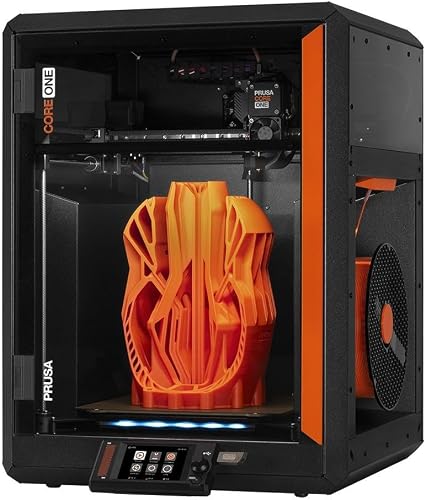
The machine’s 0.0125 mm minimum layer height is overkill for most scenery, but it matters when you print rooftops at a shallow angle, where stepping artifacts would otherwise show under raking layout light. If you are still comparing platforms before you commit, our Prusa MK4S review covers the print-quality envelope in detail, and Prusa MK4S vs Bambu Lab P1S is the most common cross-shop for modelers debating enclosure and speed trade-offs.
Choose the right nozzle and filament for HO detail
The single biggest quality lever is the nozzle. A 0.4 mm brass nozzle is fine for landforms, retaining walls, ballast jigs, and the bulk of a structure’s shell. Swap to a 0.25 mm nozzle for window frames, signage, fence pickets, telegraph poles, figures, and any part with sub-millimeter features. The MK4S Nextruder makes the swap a two-minute job, and PrusaSlicer ships matched profiles for both. Avoid 0.6 mm and larger for scenery — the extrusion width simply cannot resolve HO window mullions.
For filament, matte PLA is the workhorse. It scatters layout light the way painted plaster does, so layer lines effectively disappear once the part is primed. Prusament Matte, Polymaker PolyTerra, and Bambu PLA Matte all perform similarly on the MK4S. Use standard PLA for structural parts you will hide under scenery (sub-roadbed risers, tunnel liners, bridge piers) because it is stiffer and cheaper. Keep PETG for outdoor or garden-railroad parts only — its glossiness fights you during painting. If you are new to the material, our guide to PLA filament covers the temperature, humidity, and storage basics that matter most for fine prints.
PrusaSlicer settings that actually move the needle
Start from the bundled 0.16 mm QUALITY profile for the 0.4 mm nozzle, or the 0.10 mm DETAIL profile for the 0.25 mm nozzle, then make these targeted changes:
- Layer height: 0.12 mm for buildings and rolling-stock details, 0.16–0.20 mm for rocks and terrain. Variable layer height shines on sloped roofs — let the slicer drop to 0.08 mm on the shallow faces.
- Perimeters: 3 perimeters for structures (prevents see-through walls at backlit windows), 2 for terrain.
- External perimeter speed: 30–40 mm/s. Slowing the outer wall is the cheapest way to clean up brick mortar lines.
- Infill: 10–15% gyroid is plenty. Scenery is rarely load-bearing.
- Top/bottom layers: 5 each for buildings so roof tiles do not pillow.
- Seam position: Rear — or use the paint-on seam tool to hide it behind a downspout or corner trim.
- Detect thin walls: ON. Window mullions are exactly the geometry this setting was written for.
- Arachne perimeter generator: ON. It handles variable-width features (siding profiles, window sills) far better than Classic.
Leave input shaper and pressure advance at the calibrated defaults — the MK4S ships tuned, and re-running calibration on a partly worn bed often makes things worse. If your first prints show ghosting or under-extrusion at corners, our 3D printer troubleshooting guide walks through the diagnostic order before you start changing settings.
Where to get HO scenery models
You do not need to model from scratch. Several communities publish HO-scale STLs that print well on the MK4S:
- Printables — the “HO scale” and “model railroad” tags are well populated, and many designers post Prusa-tested profiles alongside the STL.
- Thingiverse — older but deep; search for “HO 1:87” rather than just “HO” to filter out home-organization parts.
- Cults3D and MyMiniFactory — more paid content, often higher detail. Look for designers who explicitly cite FDM-friendly geometry.
- Open-source railroad projects like the Free-mo and NMRA community libraries publish reference dimensions you can use to validate scale before committing to a 10-hour print.
When you import an STL, always verify the model scale: many files are uploaded at 1:1 (real-world meters) or pre-scaled to 1:160 (N scale). In PrusaSlicer, an HO boxcar should measure roughly 116 mm long over the body, a passenger coach 235–260 mm, and a single-story house footprint 80–120 mm on a side. If the dimensions look off by a factor of 1.83, the file is N-scale — scale by 183% to convert.
Orientation, supports, and bed adhesion
Orient buildings with the largest flat wall on the bed and slice each storey as a separate part if the model allows; this lets you print window frames flat (no overhangs on the mullions) and glue the structure together afterward. For tunnel portals and retaining walls, print the decorative face up and the back flat on the bed — the textured PEI sheet will leave a usable concrete texture on the hidden side. Rock castings should be sliced with the cliff face angled 10–20 degrees off vertical to minimize support contact on the visible surface.
Use organic (tree) supports for figures, signal masts, and locomotive details. Use snug grid supports for rooftop details and chimneys. Keep the support interface at 0.2 mm Z-distance — tighter and you will tear surface detail removing them. Bed adhesion is rarely a problem on a clean textured sheet; if you do see corners lift, a 5 mm brim is cheaper than a failed 8-hour scenery print.
Painting and finishing
FDM scenery looks plastic until it is primed. A rattle-can of grey or rust-red automotive filler primer kills layer lines visually and gives acrylics something to bite. After priming:
- Base coat with a flat acrylic close to the final color but one shade lighter.
- Wash with thinned dark brown or black acrylic to pool into mortar joints, board gaps, and rivet recesses. This single step is what makes printed brickwork read as brickwork.
- Drybrush with a lighter tone on edges, sills, and high points to suggest sun-bleaching.
- Weather with pastel chalks or pigment powders for rust streaks, soot, and ground grime.
- Seal with a matte clear coat to lock everything down and kill any remaining FDM sheen.
For ground cover — static grass, ballast, ground foam — print a flat base with a shallow texture and glue scenic material on top with diluted matte medium. Do not try to print grass directly; even at 0.08 mm layers it will look like corduroy.
Print-time expectations and batching
A single HO structure (small trackside shed, switch tower) runs 4–8 hours at quality settings. A row of city storefronts or a full engine house can hit 18–30 hours. Batch small details — barrels, crates, fence sections, signs — into overnight plates with a skirt rather than a brim to save material. The MK4S handles long unattended prints reliably, but if you are running multi-day jobs on a regular basis, our 3D printer maintenance guide covers the belt-tension, nozzle, and lubrication cadence that keeps quality from drifting between calibrations.
Common mistakes to avoid
- Printing whole structures as one part. Separating walls and roof lets you print each face flat, paint interiors before assembly, and add window glazing easily.
- Using glossy filament. It fights primer and shows every layer line under layout lighting.
- Skipping the wash step. Unwashed printed brick looks like a toy. A single brown wash transforms it.
- Over-scaling figures. HO figures are 20–22 mm tall. Many STLs marked “HO” are actually OO (1:76) and will tower over your rolling stock.
- Ignoring shrinkage. PLA shrinks roughly 0.2%. For parts that must mate to commercial track or turnouts, model 0.2–0.3 mm clearance into joints.
Frequently Asked Questions
What layer height should I use for HO scale buildings on a Prusa MK4S?
0.12 mm is the sweet spot for HO structures with a 0.4 mm nozzle — fine enough that primer and a wash hide the layers, fast enough that a small building still finishes in a working day. Drop to 0.08–0.10 mm with a 0.25 mm nozzle for figures, signal heads, and detail castings. Go up to 0.20 mm only for rocks and bulk terrain where surface texture will be covered with paint and scenic material anyway.
Is a 0.25 mm nozzle worth it for HO scale model train scenery?
Yes, for detail parts. Window mullions, picket fences, ladder rungs, brake wheels, and HO figures all benefit visibly from the finer extrusion width. You do not need it for walls, roofs, or terrain — keep the 0.4 mm installed for those and swap to 0.25 mm for the detail plate. The MK4S Nextruder makes nozzle swaps quick, and PrusaSlicer’s bundled profiles handle the flow recalculation.
Can I print HO scale figures on the MK4S, or do I need a resin printer?
You can print recognizable HO figures on the MK4S with a 0.25 mm nozzle and 0.08 mm layers, but facial detail will be approximate. For close-up scenes (station platforms, foreground groups) a resin printer still wins. Our FDM vs resin guide covers the trade-offs if you are considering adding a resin machine to your scenery workflow.
What is the best filament for HO scale buildings?
Matte PLA. It primes and paints like styrene, scatters light naturally, and is dimensionally stable enough for parts that need to mate to commercial track or window glazing. Standard PLA works for hidden structural parts. Avoid PETG (too glossy), ABS (warping risk on large flat walls), and TPU (impossible to paint cleanly) for scenery work.
How do I print transparent windows for HO buildings?
Do not try to print the glazing itself — FDM-printed “clear” PLA is cloudy at HO scale. Instead, design or modify the window opening to accept a piece of clear styrene or acetate sheet (0.25–0.50 mm thick) glued in from behind. Print the window frame and mullions as a separate flat part, then sandwich the glazing between the frame and the wall during assembly.
How long does it take to print a typical HO structure on the MK4S?
A trackside shed or small switch tower takes 4–8 hours at 0.12 mm layers. A two-story station building runs 12–18 hours. A full engine house or large industrial complex can take 24–36 hours. Splitting the model into walls, roof, and details lets you batch parts efficiently and keeps any single failure from costing you a full day.
Do I need an enclosure to print HO scenery on the Prusa MK4S?
Not for PLA, which is what you should be using for scenery. The open MK4S is fine. An enclosure only matters if you move to ABS or ASA for outdoor garden-railroad parts. If you are weighing enclosed alternatives anyway, our roundup of the best enclosed 3D printers covers the options worth shortlisting.
Key Takeaways
- Choosing the right how to print ho scale model train scenery on prusa mk4s means matching the key features to your specific needs and budget
- Read real customer reviews and check the return policy before you commit
- Also covers: prusa mk4s ho scale building settings
- Also covers: model railroad 3d printing prusa
- Also covers: ho scale terrain mk4s slicer profile
- Compare value across models — the priciest option is not always the best fit