Disclosure: As an Amazon Associate we earn from qualifying purchases.
If you're weighing the bambu p1p vs anycubic kobra 3 combo multicolor beginners decision, here's the short answer: the Bambu Lab P1P paired with its AMS multi-material unit is the smoother on-ramp for first-time multicolor printing, while the Anycubic Kobra 3 Combo undercuts it on price and offers a more open ecosystem at the cost of a slightly steeper learning curve. Both machines can produce stunning four-color prints out of the box in 2026, but they take very different paths to get there. This guide breaks down which is genuinely better for someone brand-new to FDM.
Quick verdict for multicolor newcomers
If your goal is to unbox a printer, run the calibration wizard, and have a four-color Benchy in your hands the same afternoon, the Bambu P1P + AMS is the safer pick. Bambu's hardware-software integration is the tightest in the consumer space, and the AMS unit handles filament changes with very little fuss once it's set up. The Kobra 3 Combo is the better choice if you care about price-per-color, want to swap in third-party spools without flags or warnings, and are comfortable spending an extra evening dialing the printer in.
When shopping for bambu p1p vs anycubic kobra 3 combo multicolor beginners, it pays to compare specs, capacity, and real-world runtime before committing.
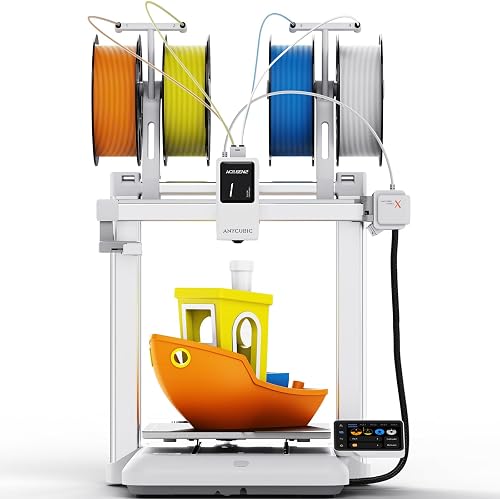
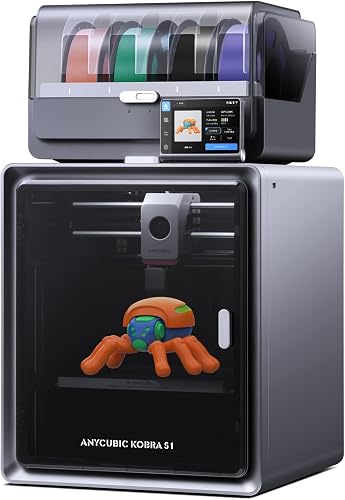
The two machines target the same shopper but solve the problem differently: Bambu sells you a managed experience, Anycubic sells you a capable open machine for less money. Neither is wrong, and neither is a bad first printer.
Head-to-head comparison
| Feature | Bambu P1P + AMS | Anycubic Kobra 3 Combo |
|---|---|---|
| Build volume | 256 × 256 × 256 mm | 250 × 250 × 260 mm |
| Kinematics | CoreXY | CoreXY |
| Max travel speed | 500 mm/s | 600 mm/s |
| Multicolor unit | AMS (4 spools, expandable to 16) | ACE Pro (4 spools, expandable to 16) |
| Filament drying | No (AMS Pro adds this) | Yes, built into ACE Pro |
| First-layer scan | LiDAR + auto bed level | Strain-gauge auto bed level |
| Slicer | Bambu Studio / Orca | Anycubic Slicer Next / Orca |
| Enclosure | Open frame | Open frame |
| Cloud printing | Bambu Handy + Cloud | Anycubic App + Cloud |
| Third-party filament | Works, no RFID | Works, no restrictions |
| Typical Combo price (2026) | Higher | Lower |
Bambu Lab P1P with AMS: the easy path
The P1P is Bambu's open-frame CoreXY workhorse. On its own it's a single-color printer, but bolting on the AMS (Automatic Material System) turns it into a four-color machine, and chaining AMS units pushes that to 16 colors. For a beginner, the appeal is obvious: Bambu Studio (or Orca Slicer with a Bambu profile) generates the gcode, the printer reads it, and the AMS handles the rest. Color changes are clean, the purge tower is automatic, and the LiDAR-assisted first-layer scan catches a lot of beginner mistakes before they become wasted filament.
The trade-offs are well known. The P1P is open-frame, which limits how well it handles ABS, ASA, and other warpy materials unless you build or buy an enclosure. Bambu's ecosystem also nudges you toward their own filament with RFID tags — third-party spools work fine, you just lose the auto-detection convenience. And the AMS itself adds a meaningful chunk to the sticker price, so the total cost of a P1P Combo is usually noticeably higher than a Kobra 3 Combo.
For more context on Bambu's broader lineup and how the P1P sits next to its enclosed sibling, our Bambu Lab P1S review covers the closely related model that adds a glass-and-metal enclosure.
Anycubic Kobra 3 Combo with ACE Pro: the value play
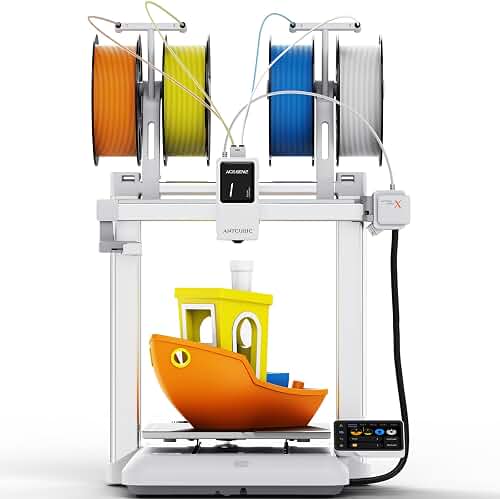
The Kobra 3 Combo bundles the Kobra 3 printer with Anycubic's ACE Pro multi-color unit, which holds four spools and feeds them into the toolhead one at a time, much like the AMS. On paper the spec sheet is competitive: 600 mm/s top speed, auto bed leveling, vibration compensation, and a touchscreen that's actually pleasant to use. In practice, the Kobra 3 prints quickly and quietly, and the ACE Pro's filament-drying feature is a genuinely useful add-on that the base AMS lacks.
What you give up is the polish. Anycubic's slicer is a fork of PrusaSlicer, and while it works, it doesn't have the same one-click confidence Bambu Studio gives a brand-new user. Multicolor calibration takes a bit more handholding the first time, and community profiles for Orca Slicer are catching up but aren't as mature as Bambu's. The flip side: every part is repairable with standard hardware, replacement nozzles are cheap, and you're not locked into a single vendor's filament marketplace.
Which is genuinely friendlier for beginners?
The honest answer is that both machines are friendlier than any single-color printer you'd have bought three years ago. Auto bed leveling, input shaping, and pre-tuned profiles have flattened the FDM learning curve dramatically. That said, when we look at the bambu p1p vs anycubic kobra 3 combo multicolor beginners question specifically, the P1P wins on first-week experience by a small but meaningful margin.
Here's why: the failure modes of multicolor printing are different from single-color. A clogged filament cutter, a missed retraction, or a poorly-tuned purge volume can ruin a 14-hour print. Bambu has had two years of firmware iteration on these exact problems, and the defaults just work. Anycubic is closing the gap, but you'll occasionally find yourself reading forum threads to fix a swap that the P1P would have handled silently.
If you're entirely new to 3D printing and want a refresher on the fundamentals before you commit, our how to choose a 3D printer guide walks through the questions to ask yourself first.
Filament, waste, and the hidden cost of multicolor
Both AMS and ACE Pro work the same way mechanically: they purge the previous color out of the hot end before switching to the next. That purge becomes a "poop" tower or wipe that you throw away. On a small four-color print, you can easily generate as much waste filament as the model itself weighs. This is the single biggest surprise for multicolor beginners.
The P1P's slicer has slightly smarter purge-volume calculations and a "flush into infill" option that's well-tuned out of the box. The Kobra 3's slicer has the same features, but tuning the per-color flush volumes is a manual chore the first few prints. Plan on buying an extra kilogram of cheap PLA in a neutral color just to soak up purges — both machines will burn through it.
If you're not sure what filament to start with at all, our guide to PLA filament is a sensible first stop. PLA is what you should be printing for at least your first month with either machine.
Software and slicer experience
Bambu Studio is a fork of PrusaSlicer with significant additions for Bambu's hardware. The cloud integration means you can slice on a desktop, send to the printer over Wi-Fi, and monitor from your phone without configuring anything. For multicolor, the painting tools are mature: you can color individual faces, fuzzy-select regions, or assign colors by STL component if your model is multi-part.
Anycubic Slicer Next is also PrusaSlicer-based and has caught up substantially in 2026. Painting works, multi-part assignment works, and the cloud printing pipeline is reliable. The interface is denser and the defaults are less forgiving, but power users actually tend to prefer it once they've spent a few hours in it. Many Kobra 3 owners run Orca Slicer instead, which is what we'd recommend if you're comfortable installing a community profile.
Print quality and speed in practice
Both printers will hit 300+ mm/s reliably on normal geometry and produce parts that are visually indistinguishable from each other at typical settings. The P1P has a slight edge in first-layer consistency thanks to the LiDAR scan, and a slight edge in dimensional accuracy because of its tighter factory calibration. The Kobra 3 is genuinely faster on travel-heavy prints and its quick-swap nozzle is easier to clear when a multicolor swap jams.
Neither machine is going to outperform a tuned Prusa MK4S on absolute quality, but both are well ahead of what beginners need. For broader context on where these sit in the wider speed-focused market, see our roundup of the best high-speed 3D printers.
Upgradability and long-term ownership
This is where the two ecosystems diverge most clearly. The P1P is upgradable within Bambu's ecosystem: you can add an enclosure kit, upgrade to the hardened steel nozzle for abrasive filaments, add more AMS units, and eventually trade up to an X1C if you outgrow it. What you can't easily do is swap in a third-party hotend or a different toolhead — the system is closed by design.
The Kobra 3 is essentially a Voron-influenced open platform. Replacement parts are cheap, the community is producing aftermarket toolheads, and you can run any nozzle that fits the standard mount. If you're the kind of person who enjoys tinkering, the Kobra 3 will reward you for years. If you'd rather print than tweak, that openness doesn't matter much.
Our pick for multicolor beginners in 2026
For a true beginner whose primary goal is multicolor prints with the least friction, the Bambu P1P Combo is the recommendation. The premium you pay over the Kobra 3 buys you fewer failed prints in your first month, a slicer that holds your hand through purge tuning, and a multicolor pipeline that has been hammered on by hundreds of thousands of users.
For a value-conscious beginner who's willing to spend an extra weekend learning the ropes — or who simply wants to spend the savings on more filament — the Kobra 3 Combo is the smarter buy. The built-in filament drying alone justifies a serious look, and the open ecosystem means you'll never be locked into a single vendor.
Still narrowing the field? Our roundup of the best 3D printers for beginners has cross-shopping suggestions including single-color options that may suit you better if multicolor turns out not to be a priority.
Frequently Asked Questions
Is the Bambu P1P or Anycubic Kobra 3 Combo easier to set up out of the box?
The Bambu P1P Combo is marginally easier. Both ship mostly assembled with quick-start calibration wizards, but Bambu's wizard is more forgiving of common first-time mistakes like an unlevel surface or partially-seated filament. Expect about 30 minutes from box to first print on either machine.
How many colors can each printer actually print in one job?
Out of the box, both support four colors via a single AMS or ACE Pro unit. By chaining multiple units, both ecosystems support up to 16 colors in a single print, though tower waste scales quickly and most beginners stick with four.
Can I use third-party filament with the Bambu P1P AMS without problems?
Yes. The AMS reads RFID tags from Bambu-branded spools to auto-configure settings, but third-party filament works fine — you just manually select the filament type in the slicer. Cardboard spools sometimes shed dust inside the AMS, so reusable plastic spools are recommended.
Does the Anycubic Kobra 3 Combo really dry filament while printing?
The ACE Pro has integrated heaters that can dry filament between or during prints. It's not a replacement for a dedicated high-temperature dryer for nylon or PETG, but for keeping PLA and PETG at a usable moisture level over weeks, it works well and is genuinely a feature the base Bambu AMS doesn't offer.
How much filament does multicolor printing actually waste?
Plan for purge waste of roughly 30 to 60 percent of the model's own weight on a four-color print, depending on how often colors swap per layer. Both slicers can route some of that into infill to reduce visible waste, but you should budget for it regardless.
Should I get an enclosed printer instead if I want to print ABS later?
If ABS, ASA, or polycarbonate are on your roadmap, neither the P1P Combo nor the Kobra 3 Combo is ideal in its open-frame form. The Bambu P1S (an enclosed P1P) or a dedicated enclosed model from our best enclosed 3D printers roundup would serve you better long term.
Is the Kobra 3 Combo's multicolor quality really comparable to Bambu's?
For visual quality on finished prints, yes — color sharpness and seam quality are essentially equivalent. The differences show up in reliability and convenience: the Bambu pipeline has fewer failed swaps over hundreds of prints, while the Kobra 3 requires occasional manual intervention until you've dialed in your purge volumes.
Can either of these handle resin-like detail for miniatures?
No. Both are FDM printers and will be outperformed by even an entry-level resin printer for miniature detail. If small detailed figures are your goal, a resin machine is the right tool — see our best resin 3D printers guide instead.
Key Takeaways
- Choosing the right bambu p1p vs anycubic kobra 3 combo multicolor beginners means matching the key features to your specific needs and budget
- Read real customer reviews and check the return policy before you commit
- Also covers: p1p ams vs kobra 3 ace pro
- Also covers: first multicolor printer p1p or kobra 3
- Also covers: kobra 3 combo vs p1p print quality
- Compare value across models — the priciest option is not always the best fit