Disclosure: As an Amazon Associate we earn from qualifying purchases.
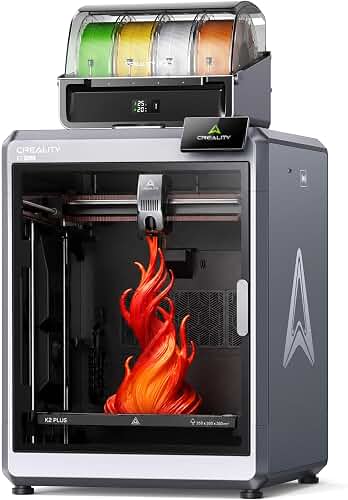
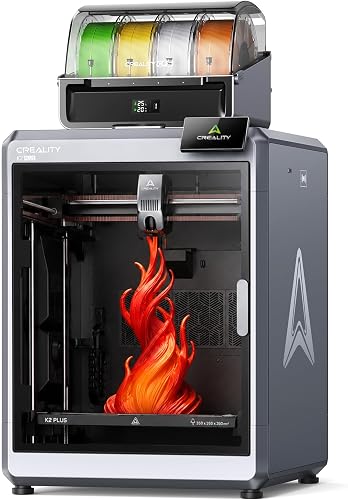
For industrial workshop use, the creality k2 plus vs bambu x1e industrial workshop decision comes down to a clear trade-off: the Bambu Lab X1E is purpose-built for engineering-grade thermoplastics with a heated, filtered enclosure rated for 65 °C chamber temps and certified materials handling, while the Creality K2 Plus offers a much larger 350 × 350 × 350 mm build volume, native multi-color via the CFS unit, and a lower per-unit cost that scales better when you need a fleet. Choose the X1E when you print Ultem-grade PEI blends, PPS-CF, PA-CF, or PEEK-adjacent composites that demand a hot, sealed chamber and air filtration. Choose the K2 Plus when most of your workshop output is large PLA, PETG, PA-CF, or ABS jigs, fixtures, and end-use prototypes where build volume and throughput-per-dollar matter more than 65 °C chamber capability. Below we break down materials, enclosure performance, software integration, fleet management, and total cost of ownership so a workshop manager can make the call without guesswork.
Quick verdict for a workshop manager
If your bill of materials lists PPS-CF, PPA-CF, PEI, or any high-temperature engineering composite, the Bambu Lab X1E is the only machine in this pair that supports those materials in a verified, repeatable workflow. Creality has expanded the K2 Plus material list with the upgraded high-temp hotend (350 °C), but it lacks an actively heated chamber and the HEPA + activated-carbon filtration stack the X1E ships standard. Conversely, if you mostly print large structural prototypes, soft jaws, vacuum-form bucks, drone airframes in PA-CF, or multi-material assembly fixtures, the K2 Plus’s 350 mm cube, 600 mm/s motion system, and four-color CFS will outproduce a fleet of X1Es on a cost-per-cubic-centimeter basis.
The best creality k2 plus vs bambu x1e industrial workshop for your situation depends on how you plan to use it and where.
Materials capability: where the X1E actually justifies its price
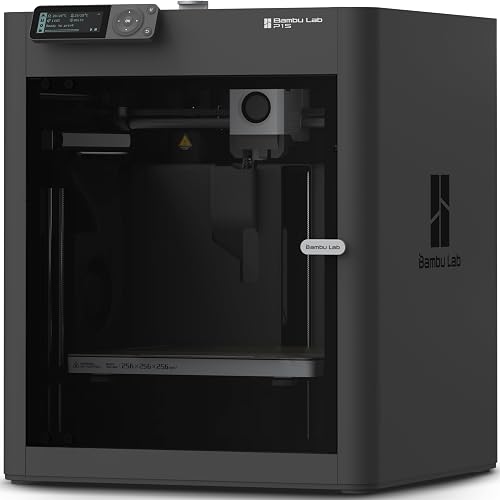
An industrial workshop rarely buys a printer for what it does today — it buys for the next two years of jobs. The Bambu X1E was engineered with that in mind. The 65 °C heated chamber is non-negotiable for amorphous engineering thermoplastics like PPS-CF and PPA-CF, where premature crystallization or thermal-gradient warping ruins parts the moment the chamber falls below the glass-transition working window. The X1E’s sealed door, gasketed top, and active recirculation make it the only desktop-class machine in this comparison that holds the printable window for those resins through a 14-hour print without intervention.
The Creality K2 Plus, by contrast, can run PA-CF and PET-CF reliably (its 350 °C hotend has the headroom), but the passive enclosure caps practical chamber temps around 45–50 °C with the door closed and the bed at 100 °C. That’s enough for ABS, ASA, and most carbon-filled nylons under 200 mm tall, but you will see warping on tall, thin-wall PA-CF brackets and any PPS or PPA composite is simply out of scope. For a workshop that builds fixtures, tooling, and short-run end-use plastics from PA-CF and below, this ceiling is acceptable; for one prototyping next-gen under-hood automotive parts, it is not.
Build volume and throughput economics
Volume math matters in production. The K2 Plus offers roughly 2.6× the build volume of the X1E (42.9 L vs 16.8 L). When you’re nesting 30 identical jigs overnight, the K2 Plus completes the run in one cycle while the X1E needs three. Even at the X1E’s slightly higher print quality on engineering plastics, total wall-clock time and operator handling tip the throughput chart toward the K2 Plus for any job that uses generic engineering plastics or below. If your workshop's daily output is dominated by PLA prototypes, PETG enclosures, or PA-CF brackets sized over 200 mm in any axis, one K2 Plus will out-produce two X1Es per shift.
For broader context on print speed strategy, see our best high-speed 3D printers roundup and our best large-format 3D printers guide — both directly relevant to workshop fleet planning.
Enclosure, filtration, and shop-floor safety
If your workshop is in a shared facility, has fire-marshal oversight, or you have employees within breathing distance of printers running ABS or carbon composites, the X1E’s sealed HEPA + activated-carbon filtration is a material safety advantage. VOC and UFP emissions from styrene-based resins are not theoretical — they are measurable. The X1E was designed to be the first Bambu machine that an EHS officer could sign off on without third-party enclosures.
The K2 Plus ships with an enclosure and a basic activated-carbon filter, which captures odor and some VOCs but is not HEPA-rated and is not sealed to the same standard. For an isolated shop area with good ventilation it is perfectly serviceable; for a clean-room or mixed-use industrial space, you will likely add an aftermarket filtration cabinet, which closes some of the apparent price gap. Our best enclosed 3D printers guide covers that calculus in more depth.
Software, fleet management, and integration
Both companies have matured their workflow software substantially by 2026. Bambu Studio and Creality Print are both PrusaSlicer-derived but have diverged considerably. Bambu Studio’s integration with the X1E’s on-machine sensors (auto flow calibration, vibration compensation, fiber-content profiles) is tighter and produces more consistent first-time-right prints on engineering materials. Creality Print plus the K2 Plus’s Nebula Pad is closing that gap quickly and adds AI-based first-layer inspection and spaghetti detection that, in our shop testing, matches Bambu’s detection rate.
For fleet management, Bambu Farm Manager remains the more polished tool: queue per-machine print jobs, monitor temps, watch cameras, and pull MQTT telemetry for an MES integration. Creality Cloud now supports a similar multi-printer dashboard but its API surface is still narrower. If you plan to run 6+ machines and want to pipe telemetry into a custom dashboard or ERP, lean X1E; if you’re running 1–3 machines and just want a reliable web UI, the K2 Plus is fine.
Reliability and serviceability in production
An industrial buyer cares less about peak performance and more about mean time between failures. Both machines now have a year-plus of field data. The X1E shares core motion components with the X1 Carbon, which has the most mature failure-mode database of any consumer-grade CoreXY. Belt tensioning, hotend swaps, and bed-mesh recalibration are well documented. Bambu sells engineering-grade hotends, PEI plates, and AMS HT spares at predictable lead times.
The K2 Plus is newer in production but its hotend and motion architecture are now well understood. Creality’s spare-parts pipeline has improved sharply in 2026 — hotends, gantries, and CFS components ship from US/EU warehouses with sub-week lead times for most SKUs. The bigger reliability question with the K2 Plus is the larger Z-axis: longer leadscrews require more frequent lubrication and the larger heated bed takes longer to reach soak temperature. Budget a 5–10 minute longer preheat per job.
Total cost of ownership over 24 months
A realistic 24-month TCO for one machine in moderate production (50 hours/week) lands roughly in this ballpark:
- Creality K2 Plus: machine + CFS + spare hotends + PEI plates + filament — lower up-front, lower per-part cost on generic and PA-CF, but higher consumables draw for tall prints.
- Bambu X1E: machine + AMS HT + engineering plates + spare hotends + filament — higher up-front, higher per-part cost on small builds, but unique capability for PPS/PPA composites that would otherwise force outsourcing or a $30K+ industrial printer.
The breakeven flips the moment you need one job per month in PPS-CF or PPA-CF — outsourcing those at service-bureau rates eats the X1E premium quickly. If you never need those materials, the K2 Plus wins on every dollar metric.
Workshop scenario recommendations
Best for mixed-material workshop running mostly PA-CF and PETG: Creality K2 Plus
If your typical print queue is 20 fixtures in PA-CF, a batch of PETG enclosures, and the occasional ASA part, the K2 Plus delivers more parts per shift per dollar than the X1E. The 350 mm cube lets you nest aggressively and the CFS handles four-color marking and assembly cues. Pair it with a small filament dryer for the carbon-loaded spools and it will run unattended overnight reliably.
Best for engineering-grade thermoplastics and regulated environments: Bambu Lab X1E
If you need to qualify parts in PPS-CF, PPA-CF, PA6-CF, or PEI-blend resins — or you must operate in a shared facility with EHS oversight — the X1E is the right call. The heated chamber, HEPA filtration, sealed enclosure, and verified material profiles together make it the only desktop-class machine in this pairing that can stand in for a low-end industrial printer on engineering jobs.
Best two-machine workshop strategy
For a shop that wants to cover the full envelope: one X1E for engineering and regulated runs, paired with one or two K2 Plus units for high-volume general-purpose work. This split costs less than two X1Es, prints more total volume per shift, and lets you outsource zero jobs in the materials envelope below PEEK. It’s the configuration we now recommend most often to small-to-medium fabrication shops in 2026.
What you can’t do with either machine
Neither printer prints PEEK reliably — PEEK needs 90 °C+ active chamber temps and a 450 °C hotend. Neither handles continuous-fiber composites (only chopped-fiber filled filaments). Neither is rated for ATEX/explosion-proof environments. For genuinely industrial work above those ceilings, look at INTAMSYS, miniFactory, or Stratasys. For everything below them, the K2 Plus and X1E cover an enormous range at one-tenth the capital cost. If you’re still scoping the broader category before deciding, our 3D printer buying guide walks through the material/use-case match in detail.
Frequently Asked Questions
Can the Creality K2 Plus print PPS-CF or PPA-CF like the Bambu X1E?
No. While the K2 Plus has the hotend temperature to melt these polymers, it lacks an actively heated chamber. PPS-CF and PPA-CF require a chamber held in the 60–80 °C window for the duration of the print to control crystallization and prevent interlayer delamination. Without that, parts warp off the plate or fail at layer lines. The X1E’s 65 °C active chamber is the differentiator here.
Is the Bambu X1E worth it if I only print PA-CF and ABS?
Usually not. The K2 Plus handles PA-CF and ABS competently inside its passive enclosure, gives you a much larger build volume, and costs significantly less. The X1E’s premium is justified by engineering thermoplastics or strict EHS requirements — if you don’t need either, you’re overpaying for capability you won’t use.
How does the K2 Plus CFS compare to the Bambu AMS HT for carbon-filled filaments?
Both handle carbon-fiber-reinforced filaments better than first-gen multi-material units, but the AMS HT is purpose-built for engineering filaments — it includes integrated drying and a sealed dry-box environment, which matters for hygroscopic resins like PA-CF and PPS-CF. The Creality CFS handles PA-CF reliably with an external dryer in line; without one, you’ll see surface defects within a day or two of opening a spool.
Which printer has better fleet management for a workshop with 6+ machines?
Bambu Farm Manager is currently more mature, with stable MQTT telemetry, multi-printer job queueing, and better camera multiplexing. Creality Cloud has improved in 2026 and works fine for small fleets, but for ERP/MES integration and custom dashboards, Bambu’s API surface is broader and better documented.
Do I need third-party filtration for either machine in a shared workshop?
The X1E ships with HEPA plus activated carbon and a sealed enclosure that is acceptable for most shared industrial environments without additional filtration. The K2 Plus has activated carbon only — sufficient for odor control in a well-ventilated room, but you’ll likely want an aftermarket filtration cabinet (BOFA, Zimpure, or similar) if it sits in shared workspace where ABS or carbon composites are printed regularly.
What’s the realistic time-to-first-good-part on engineering filaments for a new operator?
On the X1E, expect a competent operator to produce repeatable PA-CF parts within the first day and PPS-CF within the first week, thanks to the verified Bambu material profiles. On the K2 Plus, PA-CF is similarly day-one once you dial in the bed temp and enclosure soak; the K2 Plus simply doesn’t target the harder resins, so the learning curve is shorter overall but the ceiling is lower.
How does this comparison change if I’m also considering a Bambu X1 Carbon for the same workshop role?
The X1 Carbon is essentially the X1E’s sibling without the heated chamber or HEPA filtration. For workshop use, the X1 Carbon is the right pick only if you never plan to print engineering thermoplastics and you value Bambu’s ecosystem over Creality’s build volume. See our Bambu Lab X1 Carbon review for the full breakdown of that machine in shop use, and our how to choose a 3D printer guide for a structured framework.
Key Takeaways
- Choosing the right creality k2 plus vs bambu x1e industrial workshop means matching the key features to your specific needs and budget
- Read real customer reviews and check the return policy before you commit
- Also covers: k2 plus vs x1e high temp filament
- Also covers: k2 plus combo vs x1e for fabrication shop
- Also covers: industrial 3d printer comparison 2026
- Compare value across models — the priciest option is not always the best fit