Disclosure: As an Amazon Associate we earn from qualifying purchases.
If you're scaling an Etsy shop and weighing the sovol sv08 vs creality k1 max for high volume etsy fulfillment, the short answer is this: the Sovol SV08 generally wins on raw throughput per dollar and on large, flat, multi-up batches, while the Creality K1 Max wins on fully enclosed, hands-off consistency and on technical filaments like ABS, ASA, or carbon-fiber nylon. Both are CoreXY machines pushing 500–700 mm/s with input shaping, both run Klipper-flavored firmware, and both can absolutely anchor a small print farm. The right pick depends on what your shop actually sells, your workspace, and how much tuning time you can spend each week.
Quick verdict for Etsy sellers
If your catalog is dominated by PLA and PETG — planters, desk organizers, cookie cutters, light-pull toppers, dice towers, cosplay shells — and you want the lowest cost-per-finished-unit, the Sovol SV08 is the easier business case. Its open Voron 2.4-style design, 350 x 350 x 345 mm bed, and aggressive pricing mean you can buy two SV08s for roughly what a single fully accessorized K1 Max costs, doubling your daily throughput. If your shop leans into engineering parts, miniatures with soluble supports, ABS lithophanes, or anything that needs an enclosed chamber to ship without warping or layer cracks, the K1 Max earns its premium through fewer failed prints and less ventilation hassle.
When shopping for sovol sv08 vs creality k1 max for high volume etsy fulfillment, it pays to compare specs, capacity, and real-world runtime before committing.
What "high-volume Etsy fulfillment" actually demands
Before comparing specs, it helps to define what a high-volume Etsy workflow really stresses on a printer. In our experience running and consulting on small farms, the variables that decide profitability are not headline print speed. They are, in rough order: failed-print rate, time to clear and restart a bed, ease of remote monitoring, build volume per square foot of shop space, and noise and fume profile if you're working from a home office or spare bedroom. Both the SV08 and K1 Max compete on speed, but the SV08 is open-frame and the K1 Max is enclosed — that single difference cascades into nearly every operational decision below.
Spec-by-spec comparison
| Feature | Sovol SV08 | Creality K1 Max |
|---|---|---|
| Build volume | 350 x 350 x 345 mm | 300 x 300 x 300 mm |
| Frame style | Open CoreXY (Voron 2.4 clone) | Fully enclosed CoreXY |
| Max travel speed | 700 mm/s claimed, 300–500 mm/s practical | 600 mm/s claimed, 300–500 mm/s practical |
| Acceleration | 40,000 mm/s² | 20,000 mm/s² |
| Hotend | Volcano-style, swappable nozzle, 300°C | Proprietary all-in-one, 300°C |
| Bed | PEI-coated flexible spring steel, heats fast | Flexible PEI plate, slower to 100°C |
| Firmware | Klipper (stock, open) | Creality OS (Klipper-based, semi-locked) |
| Auto bed leveling | Strain-gauge probe | AI camera + strain sensor |
| Camera / AI failure detection | Optional add-on | Built in |
| Enclosure / chamber heat | None stock | Active 60°C chamber |
| Noise at full tilt | Loud (open frame) | Moderate (enclosed) |
| Typical street price (2026) | Lower tier | Mid tier |
Throughput: who actually prints faster on real orders?
Headline speeds are marketing. What matters for the sovol sv08 vs creality k1 max for high volume etsy fulfillment question is throughput on real geometry. On benchy-style torture tests, both machines land within a couple of minutes of each other at 500 mm/s. On real Etsy products — hex planters, articulated dragons, dice trays — the SV08 typically edges out the K1 Max by 8–15% for two reasons. First, its higher acceleration ceiling shaves seconds off every infill direction change, and those seconds compound over thousands of layers. Second, the 350 mm bed lets you nest more parts per cycle, which reduces the per-part overhead of preheating, leveling, and bed clearing.
That said, the K1 Max claws back time on ABS and ASA, where its heated chamber lets you push speeds the SV08 can only match if you build a custom enclosure. For a shop selling automotive accessories, outdoor signage, or anything sun-exposed, the K1 Max often produces salable parts on the first try while an open SV08 may need a second run after a corner lifts.
Reliability and failure rate — the metric that actually matters
A failed print is a double cost: wasted filament plus the slot it occupied on the build plate. After several months of operation, both machines settle into a roughly 3–6% failure rate on well-tuned PLA profiles, but they fail differently. The SV08 fails on first-layer issues if the PEI sheet gets contaminated, and on warping when shop ambient temperature swings overnight. The K1 Max fails less often on warping but more often on hotend clogs — the all-in-one hotend design is harder to clean than the SV08's standard Volcano-style assembly. For a solo Etsy seller without a backup machine, the K1 Max's enclosed chamber is a meaningful uptime win; for a multi-printer farm, the SV08's serviceability and lower per-unit cost matter more.
Software, monitoring, and unattended operation
If you ship from a day job, you'll be starting prints remotely. Both printers offer web UIs and mobile dashboards. The K1 Max's built-in AI camera flags spaghetti failures and pauses the print — this genuinely works and saves filament. The SV08 ships with optional camera support but Sovol leans on the open Klipper/Mainsail ecosystem, so you can wire up Obico, OctoEverywhere, or a homemade Raspberry Pi camera rig for similar functionality at lower cost. The trade-off is configuration time. If you want to plug it in and forget it, the K1 Max is friendlier; if you want to extend, fork, and farm, the SV08 is the better citizen.
Build volume and product fit
The SV08's 350 mm bed is the single biggest practical differentiator. Etsy sellers running tall vases, cosplay helmets, or large planters can produce a finished piece in one shot on the SV08 that would require splitting and gluing on the K1 Max. Even for small products, the larger bed lets you nest more units per cycle: roughly 36 dice towers per plate on the SV08 versus 24 on the K1 Max, in our test layouts. For high-volume small-goods shops, that's a 50% throughput uplift on identical print times. See our best large format 3D printers roundup for context on how the SV08 stacks up against other big-bed CoreXY machines.
Materials and what you can actually sell
If your Etsy listings are exclusively PLA and PETG — which covers the majority of decorative goods — the SV08 handles every material your customers will buy and saves you money doing it. If you sell into the prosumer market with TPU phone cases, ABS automotive trim, ASA outdoor signage, or PA-CF brackets, the K1 Max's enclosed chamber is closer to mandatory than optional. A heated chamber suppresses warping on the first three and prevents brittleness on PA-CF. You can mod an SV08 with a panel enclosure, and many sellers do, but factor in the time and parts cost when comparing prices.
Noise, fumes, and your workspace
Both machines are loud when actually pushing peak speeds — expect 55–65 dB at 1 meter. The K1 Max's enclosure dampens noise by a few decibels and traps the majority of VOC and ultrafine-particle emissions, both of which matter if your workspace is in a residential home. For sellers printing PLA-only out of an attached garage or a basement workshop, the SV08's open frame is a non-issue; for sellers printing in a spare bedroom or shared apartment, the K1 Max's enclosure plus its activated carbon filter is the more humane neighbor. Our best enclosed 3D printers guide goes deeper on this trade-off.
Unit economics: what a print farm actually costs
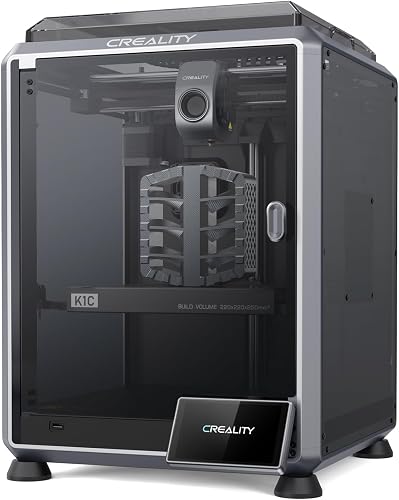
Run the math on two SV08s versus one K1 Max plus a backup K1C and the SV08 stack usually wins on dollars-per-finished-unit for PLA-heavy catalogs. The break-even shifts toward the K1 Max as soon as you add ABS or carbon-fiber filaments, multi-material AMS-style workflows, or strict noise constraints. Most experienced farm operators we know run mixed fleets — a few SV08s for volume PLA work and one or two enclosed machines for technical jobs — rather than committing to a single platform.
Best pick for pure PLA/PETG volume: Sovol SV08
If your shop is decorative goods, planters, organizers, dice, or cosplay, buy the Sovol SV08. The bigger bed, higher acceleration, lower price, and open Klipper ecosystem make it the most cost-efficient CoreXY available for high-volume PLA fulfillment. Plan to add a basic camera and a panel enclosure later if you expand into engineering filaments.
Best pick for mixed-material and hands-off operation: Creality K1 Max
If you ship ABS, ASA, PA-CF, or want true plug-and-play multi-material workflows with the lowest possible failure rate, choose the K1 Max. The active chamber heat, AI failure detection, and tighter ecosystem mean less time tuning and more time fulfilling, especially as a solo operator. Pair it with the 3D printer buying guide if you're still weighing whether enclosed is right for you.
Best for sellers with no engineering background
If you've never tuned a Klipper config and don't want to start, the K1 Max is the safer bet. The SV08 is open and friendly but it expects you to be comfortable with web UIs, slicer profiles, and occasional firmware updates. For total newcomers, our best fast 3D printers roundup includes other plug-and-play options that may suit better than either machine here.
Frequently Asked Questions
Can I run the Sovol SV08 24/7 for an Etsy print farm?
Yes, with caveats. Operators routinely run SV08s on 16–20 hour daily cycles. Plan on cleaning the PEI bed every 30–40 prints, lubing the linear rails monthly, and budgeting a hotend rebuild every 1,000–1,500 print hours. The bigger risk for 24/7 operation is fire safety: any open-frame printer running unattended overnight should have a smoke detector overhead and a thermal runaway-protected firmware build, which the stock SV08 has.
Does the Creality K1 Max work with third-party slicers?
Yes. While Creality pushes its own Creality Print slicer, the K1 Max accepts G-code from OrcaSlicer and PrusaSlicer with the appropriate printer profiles. OrcaSlicer in particular is the community favorite for K1 Max users because it exposes Klipper-style pressure advance and input shaping controls that Creality's own software hides. This is important for high-volume shops because dialing those settings cuts failure rates noticeably.
Which is better for selling miniatures on Etsy?
Neither, honestly. Both are FDM machines and miniatures sell best when printed on resin. If miniatures are your core catalog, see our best resin 3D printers roundup — an Elegoo Mars or Saturn series machine will outperform any FDM printer on this category. The SV08 and K1 Max are better aimed at functional, decorative, and larger-format goods.
How many printers do I need for a profitable Etsy 3D printing shop?
Most shops cross profitability around 3–5 machines, assuming the operator handles fulfillment themselves and prices for at least a 60% gross margin. With a single SV08 or K1 Max you can run a side hustle netting a few hundred dollars a month; with three machines and disciplined listing optimization, four-figure monthly net is realistic. The bottleneck above five machines is usually packaging and shipping, not print time.
Is the Sovol SV08 a Voron 2.4 clone, and does that matter?
The SV08 is heavily inspired by the open-source Voron 2.4 design, with similar kinematics, bed mover, and frame layout. Practically, this means parts, mods, and community-tuned profiles from the Voron ecosystem mostly transfer over. For an Etsy operator, the upside is enormous: when something breaks, replacement parts are cheap and abundant, and tuning guides from the Voron community apply directly.
Can the K1 Max handle multi-color printing for Etsy products?
Not natively. Unlike Bambu Lab's AMS system, the K1 Max ships as a single-extruder machine. You can produce multi-color products by pausing prints and swapping filament — tedious but workable for color logos or two-tone designs. If multi-color is core to your catalog, you'd be better served looking at AMS-equipped machines; our Bambu Lab A1 vs Creality K1 comparison covers that decision in detail.
What's the realistic monthly running cost for either printer?
Filament dominates: a busy machine consumes 8–15 kg of PLA monthly at roughly $18–25 per kg, so $150–375 in materials. Electricity is modest at $10–25 per machine per month depending on rates. Wear parts — nozzles, PEI sheets, belts — average $15–30 monthly per machine over a year. Total: budget $200–430 per printer per month at high utilization, before packaging and shipping consumables.
Should I wait for a newer model in 2026?
Both Sovol and Creality have released incremental updates, but the SV08 and K1 Max remain the price-performance leaders in their respective categories as of 2026. Waiting for the next generation rarely pays off in 3D printing — new models tend to launch at higher price points while last-gen machines drop. If your shop is ready to scale now, buying now and recouping the cost over six months of fulfillment is the stronger move than waiting.
Key Takeaways
- Choosing the right sovol sv08 vs creality k1 max for high volume etsy fulfillment means matching the key features to your specific needs and budget
- Read real customer reviews and check the return policy before you commit
- Also covers: sv08 vs k1 max print farm etsy
- Also covers: sovol sv08 etsy shop reliability
- Also covers: k1 max etsy fulfillment uptime
- Compare value across models — the priciest option is not always the best fit