Disclosure: As an Amazon Associate we earn from qualifying purchases.
Quick comparison: Creality K1 Max vs Bambu P1S
| Spec | Creality K1 Max | Bambu Lab P1S |
|---|---|---|
| Build volume | 300 x 300 x 300 mm | 256 x 256 x 256 mm |
| Kinematics | CoreXY, enclosed | CoreXY, enclosed |
| Max advertised speed | 600 mm/s | 500 mm/s |
| Typical realistic vase-mode speed | 150-250 mm/s | 150-250 mm/s |
| Hotend max temp | 300 C | 300 C |
| Chamber | Enclosed, passive | Enclosed, passive + active carbon filter |
| AMS / multi-color | CFS (separate add-on) | AMS Lite or AMS |
| Noise (subjective) | Louder, fan-heavy | Noticeably quieter |
| Best for | Tall, wide planters 270-300 mm | Polished planters up to 256 mm |
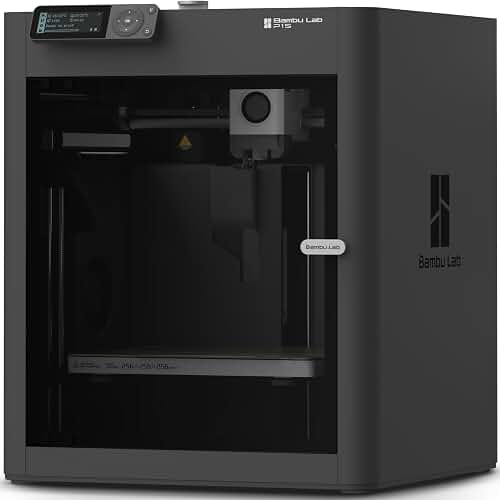
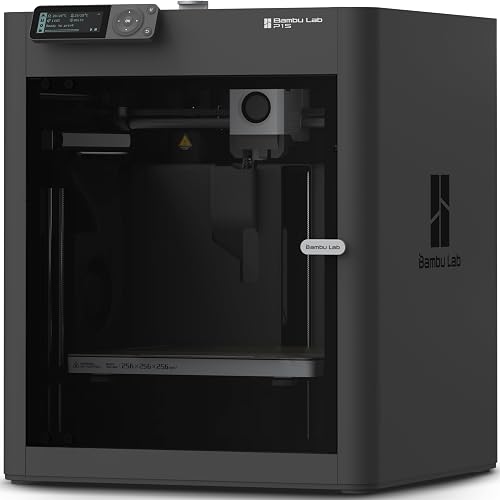
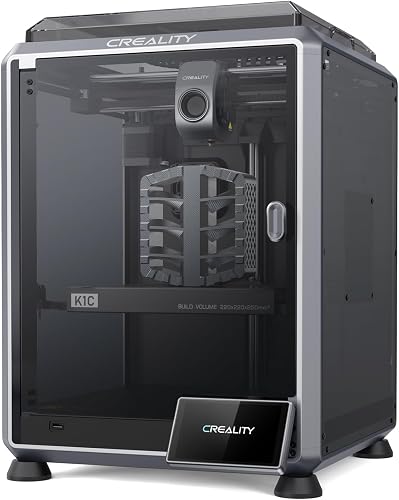
If you're choosing between the Creality K1 Max vs Bambu P1S for large vase mode planters, the short answer is this: pick the K1 Max when you need raw build volume (300x300x300 mm) to spiralize tall, wide planters in a single piece, and pick the Bambu P1S when you care more about polished surface finish, quieter operation, and lower hassle on planters under 256 mm. Both are enclosed CoreXY machines that handle PLA, PETG, and PETG-CF planter filaments well, but they make very different trade-offs once you turn on vase (spiralize) mode and start printing pieces that take 8-20 hours each.
Below I'll break down build volume, vase-mode surface quality, speed, noise, reliability for long unattended prints, and the filament choices that actually matter for outdoor and indoor planters. If you're still early in the decision, our 3D printer buying guide and how to choose a 3D printer walkthrough cover the fundamentals before you commit to either machine.
Why vase mode is the deciding factor for planters
Vase mode (also called spiralize outer contour) prints an object as a single continuous spiral of one perimeter, no top layer, no infill. That's exactly what you want for planters because it makes them watertight-ish (with a liner), fast, and dramatically lighter on filament. A 280 mm tall planter that would burn 800 g in standard mode often finishes around 250-350 g in vase mode.
But vase mode is also unforgiving. Every single visible layer line, every Z-seam shift, every fan inconsistency shows up on the outer wall because there's nothing to hide it. That's why the choice of printer matters more for planters than for, say, brackets or miniatures. If you want a primer on why layer adhesion and cooling matter so much, see how does a 3D printer work.
Build volume: where the K1 Max pulls ahead
This is the single biggest reason most planter makers gravitate to the Creality K1 Max for the creality k1 max vs bambu p1s for large vase mode planters comparison. The K1 Max's 300x300x300 mm volume gives you roughly 44 mm of extra height and 44 mm of extra diameter on every axis versus the P1S's 256x256x256 mm. That sounds small until you realize:
- A 290 mm tall floor planter fits comfortably on the K1 Max but is physically impossible in one piece on the P1S.
- Wider, squatter bowl planters (think 280 mm rim diameter) are K1 Max territory only.
- You can nest a smaller planter inside a larger one on the K1 Max plate for batch printing two pieces at once.
If your planter designs top out around 240 mm in any dimension, the P1S is fine and you'll prefer it for other reasons. But if you're doing modern brutalist pots, tall succulent towers, or floor planters for a living room, the K1 Max's larger volume is hard to beat at this price tier. For other size-driven choices, our roundup of best large format 3D printers goes deeper.
Vase-mode surface quality: where the P1S wins
The P1S, despite its smaller build, produces visibly cleaner vase-mode walls out of the box. Three reasons:
- Tighter motion calibration. Bambu's input shaping and pressure advance are tuned aggressively at the factory. Vase-mode spiral transitions show fewer ringing artifacts.
- Z-seam handling. Because vase mode is a continuous spiral, there's technically no seam, but the Z-lift at layer changes still leaves a faint diagonal line on most printers. The P1S's smoother Z-handoff makes this nearly invisible.
- Cooling. The P1S's part-cooling fan curve and chamber airflow give more consistent layer set times. On tall vases, the result is dead-uniform layer lines that catch light evenly.
The K1 Max isn't bad - it's actually faster - but you'll typically need to tune flow, pressure advance, and slow vase prints down to about 150 mm/s to match what the P1S does at stock settings. Read more about the P1S in our full Bambu Lab P1S review.
Speed and time-to-print
Both printers advertise eye-watering top speeds, but vase mode is the one mode where you shouldn't push them. Outer walls in vase mode are the visible surface - speed up and you get ringing, missed corners, and inconsistent extrusion. In practice, both printers settle around 150-250 mm/s for clean vase-mode planters.
What does differ is acceleration and how each handles overhangs. The K1 Max's beefier motion system handles wide, organic curves with less perceptible slowdown. The P1S sometimes telegraphs decel/accel on highly faceted vases. For tall narrow planters with subtle geometry, the P1S looks better. For wide, sweeping bowls, the K1 Max often gets through faster with comparable surface quality. If raw speed is a priority for non-planter work too, see our best high speed 3D printers list and best fast 3D printers comparison.
Enclosure, noise, and where the printer lives
Both machines are enclosed CoreXY designs. That matters for planters because:
- Enclosure helps with PETG and PETG-CF, which are the most popular planter filaments due to UV and water resistance.
- Enclosed printers handle warping on tall prints much better than open-frame machines.
- Most planter prints are 8-20 hour jobs - you'll want to leave them unattended, and an enclosure reduces dust and protects nosy pets.
The P1S includes an active carbon filter; the K1 Max does not by default. The P1S is also noticeably quieter - if your printer lives in a home office or bedroom, that single fact may decide the comparison. The K1 Max's part-cooling fan in particular runs aggressively and you'll hear it through a closed door.
For more enclosed options, see our best enclosed 3D printers guide.
Reliability on long, unattended prints
A 280 mm vase-mode planter at 200 mm/s typically takes 9-14 hours. That's a long time for anything to go wrong. Both printers have good first-layer auto-leveling, filament runout sensors, and pause/resume. The P1S has a slight edge in spaghetti detection via its onboard AI camera and Bambu Handy app notifications. The K1 Max has its own camera and AI detection but it's less mature.
If you're running back-to-back planter prints for an Etsy shop or local market, both will keep up, but plan on a bit more babysitting with the K1 Max in the first few months as you dial in profiles. For maintenance basics that apply to both, see how to maintain a 3D printer.
Filament considerations for planters
Both printers' 300 C hotends open up the full planter filament menu:
- PLA - cheapest, easy, indoor only. Will deform in direct summer sun. Background reading on what is PLA filament.
- PETG - the sweet spot for planters. UV-resistant, water-tolerant, prints reliably on both machines in vase mode at 230-240 C.
- PETG-CF or PETG-GF - matte stone-like finish, dimensionally stable, ideal for premium planters. Both printers handle them, but you'll want hardened nozzles (the K1 Max ships with one; P1S also has hardened steel as an option).
- ASA - the best UV and weather choice for true outdoor planters that live outside year-round. Smells and needs the enclosure - both printers qualify.
Multi-color planters: AMS vs CFS
If you want gradient or two-tone vase-mode planters, the Bambu P1S with AMS Lite (or full AMS) is currently a smoother experience. Bambu's slicer handles spiralized multi-color transitions cleanly. Creality's CFS works but the slicer-to-printer pipeline is rougher, and color transitions in vase mode can look streaky.
That said, most planter sellers stick with single-color premium filaments (matte stone, terracotta, charcoal) because they sell better than gradients. Don't pay the AMS premium just for planters unless you've already validated multi-color demand.
Which one should you buy?
Get the Creality K1 Max if...
You design planters bigger than 256 mm in any dimension, you want one printer that can also do large functional prints, you're comfortable spending an evening tuning vase-mode profiles, and you have a workshop or garage where fan noise doesn't matter. Pair it with a 0.6 mm hardened nozzle for faster planter prints with thicker, more durable walls.
Get the Bambu Lab P1S if...
Your planters fit inside 256 mm, you sell finished pieces and surface quality is your competitive edge, you want it in a living space where noise matters, and you'd rather print than tune. The P1S is also the easier path if you're newer to 3D printing - it's a near-appliance experience and our best 3D printers for beginners list calls this out.
Still on the fence?
If budget allows and you're serious about planter sales, owning both is the actual pro move - run the K1 Max for big floor planters and the P1S for premium tabletop pieces. If it has to be one, default to the K1 Max because nothing is more frustrating than designing a planter you can't physically print. For broader comparisons of the P1S against other premium options, see Bambu Lab X1 Carbon review and Prusa MK4S vs Bambu Lab P1S.
Frequently Asked Questions
Can the Bambu P1S print planters as tall as the K1 Max?
Not in one piece. The P1S maxes out at 256 mm Z, while the K1 Max gives you 300 mm. You can split a tall planter into two halves and glue them, but the seam is visible in vase mode unless you design a deliberate stepped joint. For anything over 250 mm tall, the K1 Max is the simpler choice.
What's the best vase-mode speed for planters on the K1 Max?
180-220 mm/s is the sweet spot for clean vase-mode planters on the K1 Max with PETG. Going above 250 mm/s usually introduces ringing on curved sections and reduces watertightness. With PETG-CF, drop to 150-180 mm/s to let the carbon fiber lay down evenly.
Do I need an enclosure upgrade for either printer for outdoor planter filaments?
No - both come enclosed from the factory. That's enough for PETG, PETG-CF, and ASA, which cover essentially every outdoor-rated planter filament. Neither is rated for true ABS-heavy production, but for planter filaments specifically, both enclosures are sufficient.
How thick should vase-mode walls be for planters that hold soil and water?
Aim for 1.2-1.6 mm walls, which usually means a 0.6 mm nozzle running at 1.2-1.6 mm line width. The default 0.4 mm nozzle at 0.4-0.6 mm wall is too fragile for floor planters. Both the K1 Max and P1S accept 0.6 mm nozzles, and the K1 Max ships with a hardened option that's PETG-CF ready.
Which printer has better software for planter designers?
Bambu Studio (used by the P1S) is more polished and has better vase-mode previews, including spiral seam visualization. Creality Print and the K1 Max's Klipper variant are more flexible if you want to script custom start-end G-code, but the out-of-the-box experience favors the P1S. Both accept generic STL/3MF files from Fusion 360, Blender, or Tinkercad.
Will either printer handle a 24-hour vase-mode print without issues?
Yes, both are designed for long unattended jobs. The P1S has a slight edge on automation - its spaghetti detection and remote monitoring via Bambu Handy are more mature. The K1 Max can do it too but expect to check on it once or twice. If you're running prints overnight regularly, also see how to fix 3D printer problems for common long-print failure modes.
Is the Creality K1 Max vs Bambu P1S for large vase mode planters debate going to change in 2026?
The fundamentals (build volume difference, motion-system tuning, noise) won't change without new hardware revisions. What might shift is firmware - Creality has been steadily improving K1 Max input shaping and vase-mode handling through Klipper updates, narrowing the surface-quality gap. Bambu, meanwhile, periodically expands material profiles. Check current firmware notes before deciding, but the high-level decision framework above should hold through 2026.
Key Takeaways
- Choosing the right creality k1 max vs bambu p1s for large vase mode planters means matching the key features to your specific needs and budget
- Read real customer reviews and check the return policy before you commit
- Also covers: k1 max vase mode planter comparison
- Also covers: bambu p1s spiralize outer contour
- Also covers: large planter 3d printer comparison
- Compare value across models — the priciest option is not always the best fit